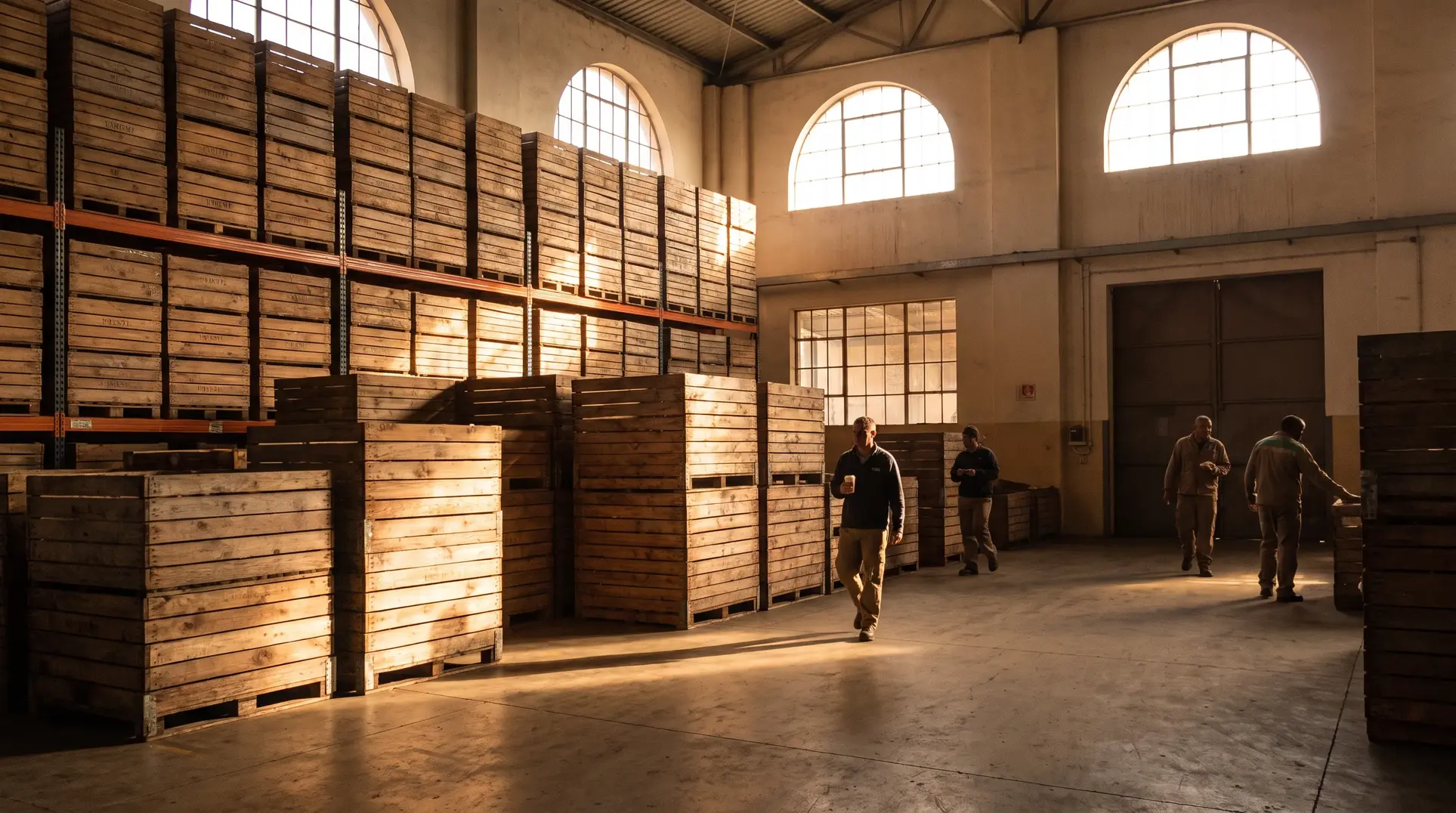
Your crate lands at a European port. Customs pulls it for inspection. The officer checks for the stamp, finds nothing recognizable, and your shipment enters quarantine. You now face a choice: pay for fumigation on foreign soil, arrange repackaging with an approved local provider, or watch your equipment get sent back across the Atlantic. None of these options are cheap. None are fast. And none were necessary.
This is what happens when wood packaging crosses international borders without proper ISPM 15 compliance. The standard exists for a reason, and understanding it before your next export shipment saves money, time, and relationships with overseas customers.
We build ISPM 15 compliant export crating services for clients shipping servers, test equipment, drones, and industrial machinery out of Canada every week. This guide explains exactly what the standard requires, how to read the stamps, and what Canadian exporters need to know to ship with confidence.
Who This Article Is For
This article is written for Canadian exporters, logistics coordinators, and procurement officers who ship wood-crated equipment internationally. If you handle servers, HVAC units, test stations, aerospace components, or manufacturing equipment crossing borders outside North America, this applies directly to your work.
This article is not for domestic shippers moving goods within Canada, retail businesses shipping consumer products in cardboard, or anyone using exclusively plastic or metal packaging. If your wood packaging never leaves North America, the requirements differ significantly.
What ISPM 15 Actually Is
ISPM 15 stands for International Standards for Phytosanitary Measures No. 15. The International Plant Protection Convention (IPPC) developed this standard to prevent invasive insects and plant diseases from spreading through wood packaging in global trade.
The standard was originally adopted in 2002 and revised in 2009 with stricter debarking requirements. Over 180 countries now enforce it. The logic is straightforward: untreated solid wood can harbour bark beetles, longhorn beetles, and other wood-boring insects that devastate forests when introduced to new ecosystems. The emerald ash borer, which has killed tens of millions of ash trees in North America, likely arrived through exactly this pathway.
ISPM 15 is not bureaucratic overhead. It is pest control at scale, and customs agencies worldwide enforce it seriously.
What Wood Packaging Materials Are Covered
The standard applies to wood packaging material (WPM) used to support, contain, or protect commodities during transport. This includes:
- Crates and boxes
- Pallets and skids
- Dunnage (loose wood used to brace or support cargo)
- Bearers and spacers
- Blocking and bracing inside containers
The thickness threshold matters: ISPM 15 applies to solid wood greater than 6mm thick. Anything below that threshold falls outside the standard’s scope.
What Is Exempt
Several materials do not require ISPM 15 treatment:
- Plywood and OSB: Manufactured using heat and glue, which eliminates pest risk
- Particleboard and hardboard: Same manufacturing process renders them safe
- Veneer and laminated wood: Heat-processed during production
- Thin wood under 6mm: Too thin to harbour pest populations
- Paper products and cardboard: Not solid wood
This exemption list matters for crate design. We often use plywood sheathing for exterior panels precisely because it provides excellent protection without expanding the volume of regulated solid wood that requires treatment and stamping.
Treatment Requirements: Heat Treatment and Debarking
ISPM 15 mandates two processes for solid wood packaging destined for export.
Debarking
All wood must be debarked before or during treatment. The revised 2009 standard allows small bark remnants under specific tolerances:
- Bark pieces less than 3cm in width (regardless of length)
- Bark pieces greater than 3cm in width only if total surface area is under 50 square centimetres per piece
These measurements matter at inspection. Customs officers check for bark, and exceeding these limits triggers non-compliance actions regardless of proper heat treatment.
Heat Treatment
The most common treatment method requires heating the wood until the core temperature reaches at least 56°C for a minimum of 30 continuous minutes. This kills insects, larvae, and eggs throughout the wood profile.
Heat treatment is chemical-free and environmentally preferred. The alternative—methyl bromide fumigation—remains technically approved but is increasingly restricted due to ozone-depleting effects. Most certified Canadian facilities use heat treatment exclusively.
According to the CFIA wood packaging requirements, only facilities registered under Canada’s Heat-Treated Wood Products Certification Program can perform compliant treatment and apply the official stamp.
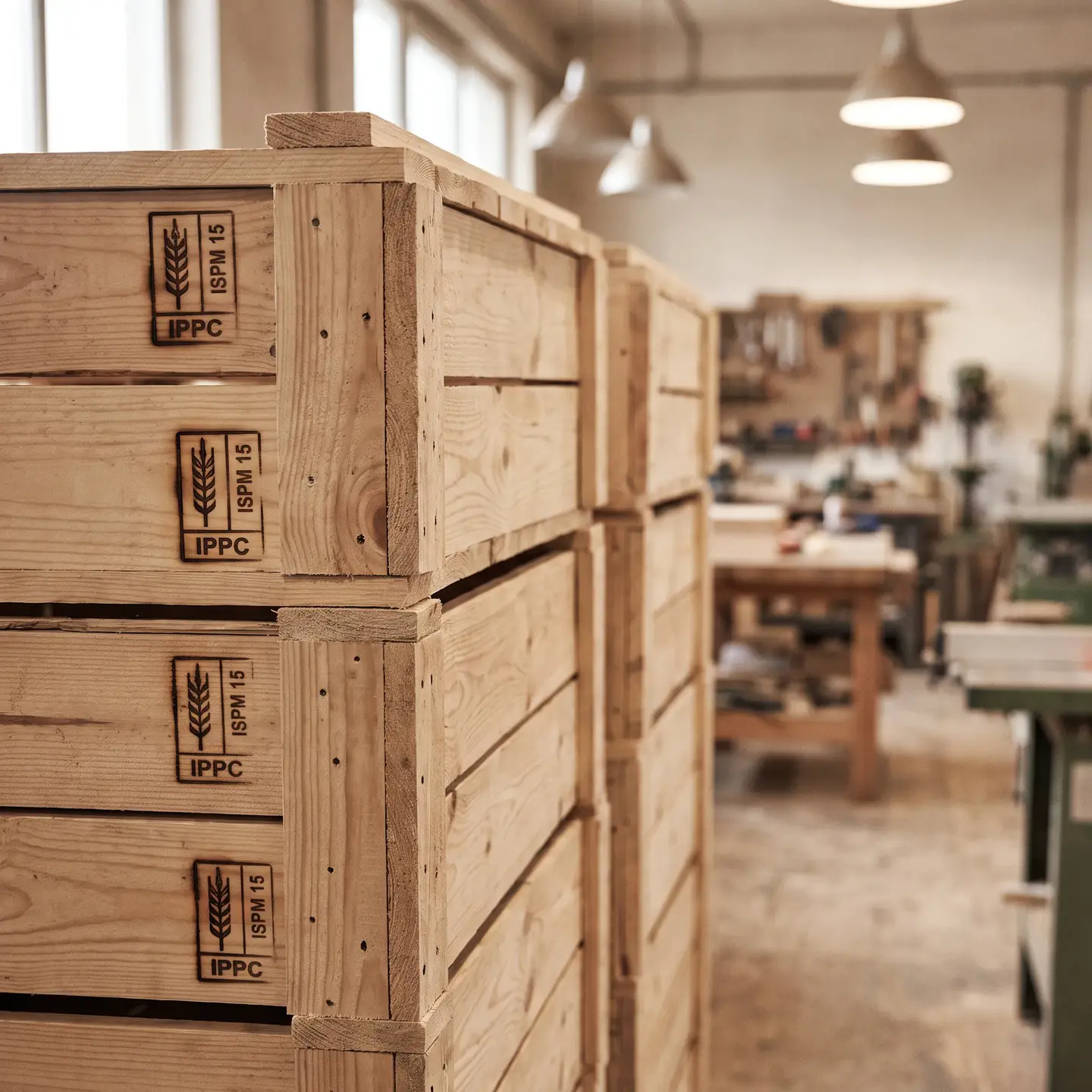
The ISPM 15 Stamp: What Each Element Means
The stamp is not just a marking. It is a legal document that proves compliance. Understanding what each element means helps you verify that your crating provider is legitimate.
A compliant stamp contains these components:
- IPPC Logo: A stylized wheat sheaf symbol on the left side, indicating compliance with International Plant Protection Convention standards
- Country Code: A two-letter ISO code (CA for Canada) identifying where the wood was treated
- Producer Code: A unique number assigned to the certified treatment facility
- Treatment Code: HT for heat treatment or MB for methyl bromide fumigation
A typical Canadian stamp reads something like: [IPPC logo] CA-1234-HT
This tells an inspector: this wood was heat treated (HT) at Canadian facility number 1234 (CA-1234) under IPPC standards.

What Makes a Stamp Valid
The stamp must be:
- Permanent: Branded or stencilled directly onto the wood, not on a tag or sticker
- Legible: Clearly readable at inspection
- Correctly formatted: Border, logo, and codes must match IPPC specifications
- Applied to actual treated wood: Not painted on untreated material
Hand-painted marks, photocopied labels, and stamps on non-wood surfaces do not meet compliance requirements. Border agents recognize fraudulent or improper marks immediately.
The Canadian Compliance Program
Canada implements ISPM 15 through the Canadian Food Inspection Agency (CFIA) under Directive D-98-08 for imports and D-13-01 for exports. The Canadian Wood Pallet and Container Association administers the certification program on CFIA’s behalf.
Only facilities registered under the Heat-Treated Wood Products Certification Program can legally produce ISPM 15 compliant packaging and apply the stamp. These facilities undergo regular audits and must maintain documented treatment protocols.
The U.S. Exemption
Canada and the United States maintain a bilateral exemption for wood packaging traded between the two countries. Under this arrangement, wood packaging moving between Canada and the continental U.S. may ship without ISPM 15 stamps if:
- The wood originates in Canada or the United States
- It was manufactured in either country
- It is free of live pests, weed seeds, and soil
- Export documents clearly state these conditions
However, if the packaging eventually moves beyond North America, ISPM 15 stamps become mandatory. Many exporters default to fully stamped packaging even for U.S. shipments to maintain flexibility and avoid confusion.
What Happens Without Compliant Packaging
Non-compliance is not a paperwork problem. It is an operational failure with immediate financial consequences.
At the Port of Entry
When customs identifies non-compliant wood packaging, several outcomes are possible:
- Immediate quarantine: Your shipment is held pending resolution
- Mandatory fumigation: Treatment performed on-site at the exporter’s or importer’s expense
- Repackaging requirement: Transfer to compliant packaging before release
- Shipment refusal: Entire consignment returned to origin
- Destruction: In severe cases, packaging and sometimes cargo are destroyed
The costs multiply quickly. Fumigation in a foreign port runs several times what treatment costs at origin. Storage fees accumulate daily. Your customer’s installation schedule slips. If your equipment sits in quarantine while a project waits, that relationship damage is difficult to repair.
Recurring Violations
Countries track compliance patterns. Repeat violations from specific exporters or countries can trigger enhanced inspection rates, meaning future shipments face automatic scrutiny regardless of individual compliance. Your company’s reputation affects inspection probability.
How to Ensure Your Shipments Are Compliant
Compliance is not complicated, but it requires attention to detail and working with the right partners.
Work with CFIA-Certified Crating Providers
Verify that your crating supplier holds current certification under Canada’s Heat-Treated Wood Products Certification Program. Ask for their facility registration number—it should match what appears on their stamps. We maintain our ISPM-15 certification and membership in the CWPCA heat treat program specifically because our clients ship internationally and cannot afford compliance failures.
Verify Stamps Before Shipping
Inspect crates before they leave your facility. Stamps should be visible, legible, and properly formatted. Photograph stamps and include images in your shipping documentation. This simple step provides evidence if questions arise at destination.
Account for All Wood Components
Non-compliance often hides in overlooked places:
- Internal blocking added after crate construction
- Dunnage placed inside containers by loading crews
- Repaired crates where new wood was substituted without treatment
- Mixed loads combining compliant and non-compliant packaging
Every piece of solid wood thicker than 6mm in your shipment must either bear a stamp or be documented as exempt material. There is no partial compliance.
Understand Destination Requirements
While ISPM 15 is the global baseline, some countries impose additional restrictions. Australia enforces stricter bark tolerances. The European Union requires full compliance with no exceptions. Certain Middle Eastern and Asian markets inspect rigorously. Research your specific destination or work with freight forwarders who understand regional enforcement patterns.
Maintain Documentation
Keep records of your crating supplier’s certification, treatment protocols, and stamp verification for each shipment. If an inspection results in questions, documentation proves your compliance chain.
The Practical Reality for Canadian Exporters
We work with defence contractors, aerospace suppliers, and technology companies shipping equipment worth hundreds of thousands of dollars. For these clients, the cost of ISPM 15 compliant crating is negligible compared to the cost of a quarantined shipment, a missed delivery window, or a damaged customer relationship.
Compliance adds nothing to your shipping timeline when built into the process from the start. A certified crating facility uses treated lumber as standard inventory. The stamps are applied during construction. No additional steps, no delays, no surprises at the border.
The official ISPM 15 standard document published by the IPPC provides the technical foundation, but practical compliance comes down to working with facilities that treat it as routine rather than an afterthought.

What to Do Next
If you ship equipment internationally in wood crates, skids, or pallets, you need ISPM 15 compliance. The standard is not optional, and the consequences of non-compliance are expensive and disruptive.
Review your current packaging chain. Confirm your crating provider holds valid CFIA certification. Implement a stamp verification step before shipments leave your facility. Document everything.
If you need compliant export crating for servers, test equipment, drones, HVAC units, or industrial machinery shipping out of the Ottawa region, request a quote from our team. We have been building certified export crates since 2011, and we understand what it takes to clear customs without complications.
Frequently Asked Questions
How does ISPM 15 non-compliance actually disrupt our international shipments?
When our wood packaging arrives without a valid ISPM 15 stamp, customs treats it as a pest risk, not a paperwork error. The shipment can be quarantined, fumigated at destination, repackaged locally, refused, or even destroyed. Each option adds days or weeks of delay, storage fees, and unexpected treatment costs. More importantly, our customer’s installation schedule slips, and a single preventable compliance miss can damage a relationship we spent years building.
Which parts of our crates and pallets are most likely to cause hidden ISPM 15 violations?
The problems usually sit in the details we add late in the process. Internal blocking installed after crate construction, loose dunnage added by loading crews, and repairs using untreated lumber routinely cause non-compliance. Mixed loads that combine stamped and unstamped wood are another common failure point. Any solid wood thicker than 6 mm must either be treated and stamped or documented as exempt material. There is no such thing as partial compliance at inspection.
How can we quickly confirm that our crating provider’s ISPM 15 stamps will pass inspection overseas?
We start by verifying that the provider is registered under Canada’s Heat-Treated Wood Products Certification Program and that their facility number matches the code on the stamp. Then we check the stamp itself: it must show the IPPC logo, “CA” country code, the unique producer number, and the HT or MB treatment code. Finally, we confirm the stamp is permanently applied, clearly legible, and placed only on treated wood components.
Do we really need ISPM 15 stamps if we only ship between Canada and the United States?
Technically, wood packaging that originates and is manufactured in Canada or the U.S. can move between the two countries without ISPM 15 stamps, as long as it is clean and pest-free. However, many of us choose stamped packaging anyway. It keeps our options open if cargo is re-exported, avoids confusion with inspectors, and standardizes our process. The small effort upfront is worth avoiding future rework when a shipment’s destination changes.
What practical steps should we build into our process to avoid costly port delays?
We treat compliance as part of our standard workflow, not a last-minute check. That means using CFIA-certified crating facilities as a rule, specifying heat-treated lumber in our packaging designs, and inspecting every crate for correct stamps before it leaves our site. We photograph stamps, keep treatment and certification records with the shipment file, and brief loading crews about dunnage requirements. These habits cost little but dramatically reduce the risk of quarantine or fumigation overseas.