
A manufacturer ships the same server chassis to the same distribution center twelve times per year. Each shipment uses a different crate configuration because each one is quoted and built as a standalone project. Some arrive with minor damage. Others arrive intact. The operations manager cannot explain the variance, and the receiving team has stopped trying to predict what unloading equipment they will need. This is the real cost of inconsistent packaging on a production line: not the price of the crate, but the cumulative friction, unpredictability, and hidden losses that accumulate across every shipment.
If your company ships high-value equipment regularly and you have noticed that packaging quality seems to vary from shipment to shipment, this article is for you. We wrote it for procurement officers, logistics coordinators, and operations managers at manufacturing companies who sense that their current crating approach is costing more than the invoice suggests. If you are shipping one-off items occasionally and cost is your only concern, this article is probably not for you. The economics we describe here apply to businesses with recurring shipping volume where consistency directly affects operational efficiency.
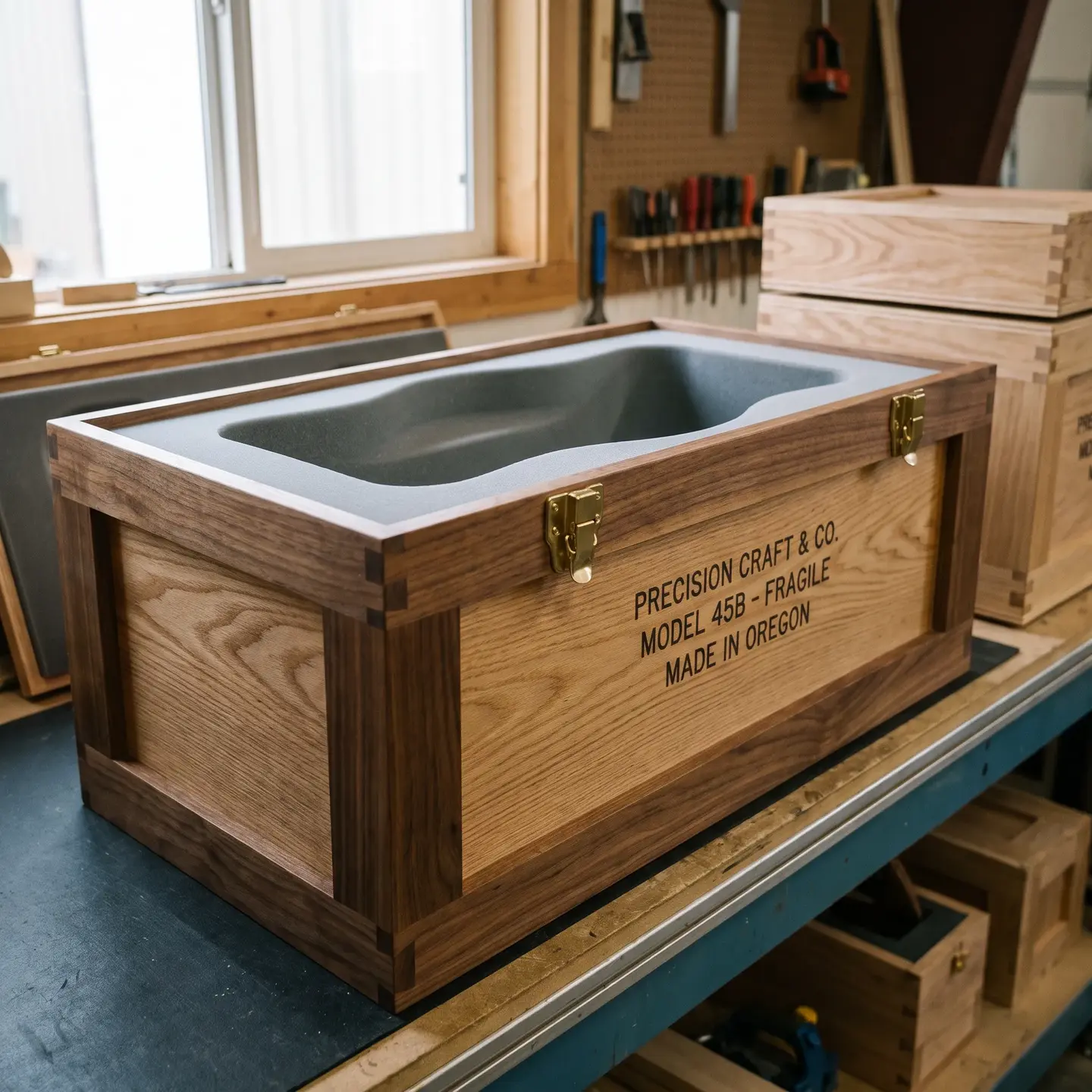
At AML Crating, we have been building production crating solutions for manufacturing clients since 2011. We have seen firsthand how inconsistent packaging creates costs that never appear on a purchase order. This article breaks down where those costs hide, how to quantify them, and when a standardized production line crating program makes business sense.
Why Inconsistent Crating Costs More Than You Calculate
The purchase price of a crate is rarely the most important cost. According to packaging industry best practices research, the total cost of packaging includes everything from line stops and manual adjustments to freight inefficiency, product damage, and compliance delays. When crating varies from shipment to shipment, every one of these cost categories becomes unpredictable.
Consider what happens when crate dimensions change slightly between orders:
- Warehouse staff cannot stack pallets efficiently because heights and footprints vary
- Container utilization drops because load planning cannot be standardized
- Receiving teams cannot prepare the correct handling equipment in advance
- Fork-entry dimensions may not match the equipment available at the destination
None of these costs appear on the crating invoice. They surface in freight bills, labor hours, and operational delays that get attributed to other causes.
The Hidden Friction Points of Improvised Crating
When every shipment is treated as a custom project, operational friction compounds across the organization. Here are the specific pain points we hear from manufacturers who contact us after years of improvised approaches.
Extended Quote Cycles
If your crating provider must assess each shipment individually, you wait for measurements, design work, and pricing on every order. For companies shipping the same product monthly, this creates an absurd situation: the same equipment gets quoted repeatedly, often by different estimators who may specify different materials or approaches.
The time cost adds up quickly:
- Operations requests a crate for a scheduled shipment
- Procurement contacts the crating provider for a quote
- The provider requests product dimensions and weight
- Someone locates the information or schedules a site visit
- The provider prepares a quote (often 2-5 business days)
- Procurement reviews and approves
- The crate is scheduled for production
For a one-time shipment, this process is reasonable. For the twelfth shipment of the same chassis, it represents pure waste. Meanwhile, your production scheduling team cannot commit to delivery dates until the crate is confirmed.
Fit Failures and Last-Minute Adjustments
Improvised crating often means the crate is designed from generic specifications rather than verified product data. When the crate arrives and does not fit the product precisely, your team makes adjustments on the shop floor: extra blocking, improvised foam pieces, repositioned bracing.
These adjustments introduce variables. The crate that worked last time might not work this time because the modifications are not documented. The person who figured out the workaround last month may not be available this month. What should be a straightforward packing operation becomes a problem-solving session.
Documentation Gaps
Inconsistent crating typically means inconsistent documentation. Pack instructions vary. Center-of-gravity markings may or may not be present. Handling symbols change. The receiving team at your customer’s facility has no way to develop standard procedures because every shipment arrives differently.
For export shipments, documentation inconsistency creates compliance risk. ISPM-15 marks must be legible and correctly applied. Treatment must be traceable. When crates come from different sources or are built without standard procedures, verification becomes difficult.
Damage Variance and Its Financial Impact
The most expensive consequence of inconsistent packaging is unpredictable damage rates. When crating varies, protection varies. Some shipments arrive intact. Others sustain damage that costs thousands to repair and weeks to resolve.
Industry data from transport insurers suggests that poor packing, securing, and load distribution contribute to roughly two-thirds of cargo damage claims. The variables that matter—blocking position, fastener pattern, foam density, base stiffness—are exactly the variables that change when crating is improvised rather than standardized.
The Downstream Costs of Damage
Product damage creates costs far beyond the repair bill:
- Replacement production: Manufacturing the replacement unit consumes capacity that was scheduled for other work
- Emergency freight: Expedited shipping to meet the original deadline costs multiples of standard rates
- Customer relationship strain: Even when claims are paid, the customer’s production line may have waited
- Administrative burden: Claims documentation, carrier coordination, and insurance processing consume staff time
- Unpredictable budgeting: Shipping costs cannot be forecast when damage rates vary between shipments
A manufacturer shipping equipment worth $200,000 cannot afford a 10% uncertainty in whether it will arrive functional. Yet that is precisely what inconsistent crating produces: an unquantifiable risk that makes planning impossible.

Receiving Confusion and Supply Chain Friction
Your packaging decisions affect your customer’s operations. When crates arrive in inconsistent configurations, receiving teams cannot prepare efficiently.
What Receiving Teams Need to Know in Advance
An efficient receiving operation depends on predictable information:
- Overall dimensions and weight
- Fork-entry positions and required equipment
- Stacking capability
- Unloading sequence and pack orientation
- Special handling requirements
- Unpacking tools and time requirements
When every shipment arrives in a different crate configuration, none of this can be communicated reliably. The receiving team either over-prepares for every possibility or under-prepares and scrambles when the shipment arrives.
According to supply chain optimization research, receiving inefficiency propagates through the supply chain. Delays at receiving affect warehouse putaway, production scheduling, and downstream delivery commitments.
Quote Cycle Time as a Competitive Disadvantage
In manufacturing, delivery commitments win contracts. When your crating approach requires a multi-day quote process for every shipment, you cannot commit to aggressive timelines.
Your competitor who has standardized their production line crating can promise delivery in predictable windows. They know exactly what their packaging will cost, how long it will take to pack, and when freight can be scheduled. You are still waiting for a quote.
This disadvantage compounds for companies serving customers with just-in-time requirements. If your customer needs equipment delivered on a specific date and you cannot confirm packaging availability until the quote process completes, you lose the ability to make firm commitments.
Production Line Crating Programs as the Solution
A production line crating program eliminates the variables that create inconsistency costs. The concept is straightforward: invest engineering effort once to design a standardized crating solution for products you ship repeatedly, then replicate that solution identically for every shipment.
The core elements of a production program include:
- Engineered specifications: Detailed drawings covering dimensions, materials, fastener patterns, foam placement, blocking positions, and all protection elements
- Documented procedures: Pack instructions that any trained operator can follow consistently
- Controlled materials: Specified lumber grades, foam densities, barrier materials, and fastener types that do not change between batches
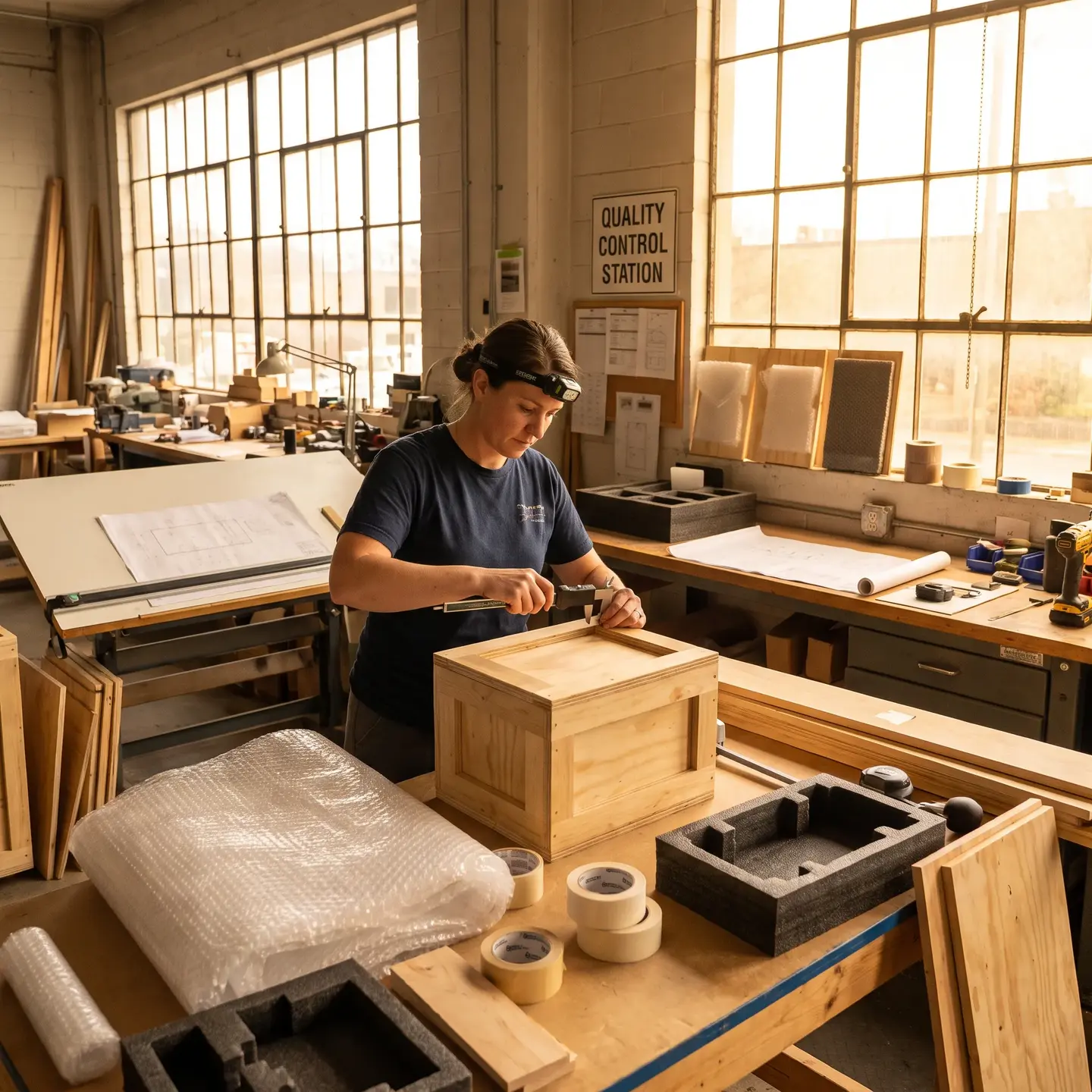
- Quality checkpoints: Verification steps that confirm each crate matches the specification before product is loaded
- Revision control: A system for managing changes so modifications are deliberate, documented, and consistent across all subsequent crates
When these elements are in place, crate number forty-seven is identical to crate number one. Damage rates become predictable. Receiving teams can develop standard procedures. Quote cycles disappear for repeat orders. The operations team knows exactly what packaging will cost and when it will be ready.
How Production Programs Reduce Per-Unit Costs
Beyond eliminating friction, standardized production crating typically costs less per unit than improvised approaches:
- No repeated design work: Engineering happens once and is amortized across all units
- Batch material purchasing: Lumber and components can be ordered in production quantities rather than small lots
- Efficient shop floor scheduling: Crate production can be batched, reducing setup time between jobs
- Reduced waste: Cut lists are optimized for the specific design rather than estimated for each order
- Predictable labor: Build times become consistent, eliminating the variance that inflates quotes
The result is typically a lower price per crate combined with dramatically lower total cost when freight efficiency, damage reduction, and operational friction are included in the calculation.
When Standardized Production Crating Makes Business Sense
Not every shipping situation requires a production crating program. The investment in engineering and specification development makes sense when:
- Shipment frequency exceeds 4-6 units annually for the same or substantially similar products
- Products are high-value where even occasional damage creates significant costs
- Receiving operations benefit from consistency because your customer or distribution network handles repeat shipments
- Delivery timelines are competitive and quote delays affect your ability to commit
- Current damage rates vary between shipments of identical products
- Compliance requirements like ISPM-15 or Controlled Goods documentation must be consistent
If you are shipping a single prototype that will never be replicated, a custom one-off crate makes sense. That is what custom crating services exist for. But if you are shipping the same test station to the same customer quarterly, treating each shipment as a custom project is paying the engineering cost four times instead of once.
Implementing a Production Crating Program
Transitioning from improvised crating to a standardized program involves several steps. The goal is to invest effort upfront so that ongoing shipments become simple, repeatable operations.
Phase 1: Product Assessment
The crating provider evaluates your products to understand:
- Exact dimensions, weight, and weight distribution
- Fragility and shock sensitivity
- Environmental sensitivities (moisture, temperature, corrosion)
- Handling constraints and lift points
- Transportation modes and destination environments
This assessment should happen once per product line. Accurate data prevents the fit failures that plague improvised approaches.
Phase 2: Crate Design and Testing
Based on the assessment, the crating provider designs a solution optimized for your specific product and distribution environment. For high-value equipment, this design should reference established standards like ASTM D7478 for heavy-duty crates or ASTM D6039 for lighter loads.
Testing validates that the design protects the product through anticipated handling. This may involve actual shipment testing or simulation based on the expected distribution hazards.
Phase 3: Documentation and Specification
The design becomes a controlled specification:
- Engineering drawings with dimensions and tolerances
- Material specifications for all components
- Fastener schedules and patterns
- Pack instructions with sequence and verification steps
- Marking and labeling requirements
- ISPM-15 treatment and mark specifications for export shipments
This documentation is the asset that enables consistency. Without it, variation creeps back in.
Phase 4: Integration with Production Scheduling
Once specifications are established, crate production can be scheduled alongside your manufacturing. The crating provider knows exactly what materials are needed and how long production takes. Orders can be placed with minimal lead time because there is no design work to complete.
Phase 5: Ongoing Optimization
As shipments accumulate, performance data identifies opportunities. If a particular route experiences higher handling stress, bracing can be reinforced. If destination feedback indicates unpacking difficulties, instructions can be refined. Changes are documented and applied to all subsequent crates.
Making the Shift
The costs of inconsistent packaging are real, but they hide in places that standard cost accounting does not capture. Freight invoices do not itemize the premium you paid for poor cube utilization. Labor tracking does not flag the extra hour spent adjusting a crate that did not fit. Damage claims get closed without tracing the variance back to packaging decisions made months earlier.
If your operation ships the same equipment repeatedly and you recognize the friction points described in this article, production line crating deserves evaluation. The question is not whether standardized crating costs more than improvised crating—the question is whether the crate price represents the actual cost you are paying.
We work with manufacturing clients across the Montreal to Toronto corridor who have made this calculation and concluded that consistency pays. If you are ready to explore whether a production crating program fits your operation, discuss your production line crating needs with our team. We can review your shipping patterns, assess your products, and determine whether standardization makes sense for your situation.
Frequently Asked Questions
When does standardized production crating make more sense than one-off crates?
We generally recommend evaluating a production crating program when we ship the same or substantially similar equipment more than 4–6 times per year. The case becomes stronger when the equipment is high-value, damage rates vary, receiving teams need predictable handling information, or multi-day quote cycles threaten delivery commitments. For a single prototype or genuinely unique shipment, we still use custom crating because the engineering investment in standardization may not be justified.
How does inconsistent crating create costs beyond the crate invoice?
We see hidden costs in repeated quote work, inefficient pallet stacking, poor container utilization, extra receiving labor, and last-minute shop-floor adjustments. Different crate footprints may also require different forklifts or unloading procedures at the destination. These costs rarely appear under “packaging,” so they are often attributed to freight, warehouse labor, or scheduling problems. Standard specifications reduce these variables and make the total shipping cost easier to forecast.
What information should a standardized crate specification include?
We document the crate’s dimensions and tolerances, lumber grades, foam density, barrier materials, fastener types, blocking locations, fork-entry positions, and product orientation. The specification should also include pack instructions, inspection checkpoints, labeling, center-of-gravity markings, and revision controls. For export shipments, we define ISPM-15 requirements where regulated solid wood is used, including treatment and legible marking requirements.
How can a production crating program reduce damage variation?
We control the variables that directly affect protection: blocking position, base stiffness, fastener pattern, bracing, and cushioning materials. Operators follow the same documented sequence, while quality checkpoints confirm that each crate matches the approved design before loading. This does not eliminate every transportation hazard, but it removes avoidable variation between shipments. Performance data can then guide controlled improvements instead of repeated improvised repairs.
What should we measure before deciding whether to standardize our crating?
We recommend tracking quote turnaround time, crate lead time, packing labor, adjustment hours, damage and claim frequency, emergency freight, receiving delays, and unloading equipment requirements. Record the shipment frequency and product value as well. Comparing these figures with one-time design and testing costs shows the real business case. If the same equipment ships quarterly and even one damage event costs thousands of dollars, standardization may pay for itself through predictability and risk reduction.