
Heavy machinery does not forgive a crate that was sized by eye, so every industrial build starts from the weight, the lift points and the load path.
Crating Built to the Load, Not the Box
Industrial cargo breaks the rules that ordinary freight follows. The weight sits in one corner instead of the middle, the shape refuses to fit anything standard, and the whole thing has to survive being lifted by a forklift at one end and a crane at the other.
A crate for that has to be engineered rather than assembled. We start from the weight distribution and the lift points, size the skids for the handling equipment at both ends, and build blocking that holds the load through every stage of the journey. The result is a crate that carries the machine, not one the machine happens to fit inside.
- Heavy machinery and production equipment
- Oversized and irregular loads
- Skids sized for forklift and crane
- Engineered blocking and bracing
- ISPM-15 stamped for export
- Onsite builds when equipment cannot travel
What We Crate
If it is too heavy, too large or too awkward for a standard container, it belongs in a crate designed around it. These are the categories we build for most often, though the principle is the same regardless of what is inside.
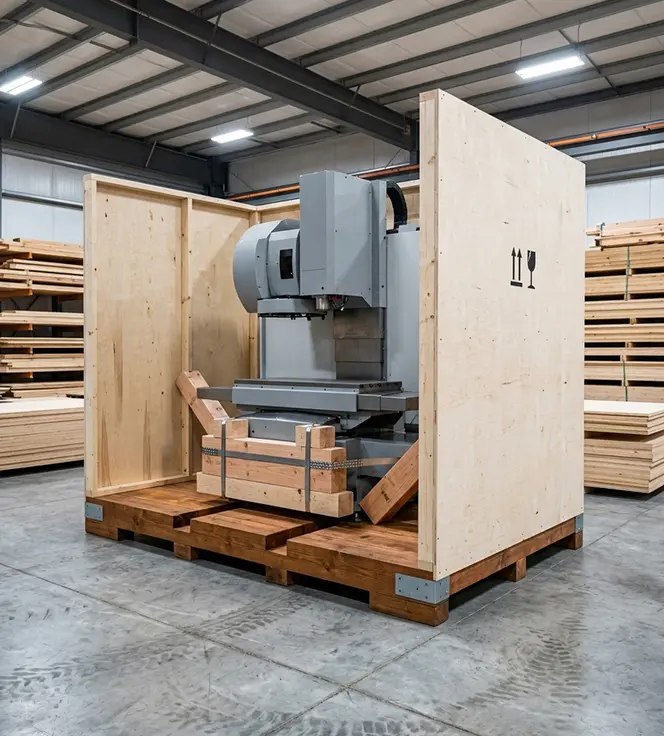
CNC machines, presses, industrial pumps, motors, gearboxes and complete production cells. These builds are engineered around the machine’s centre of gravity rather than its outside dimensions, because a crate that balances wrong is a crate that gets dropped.
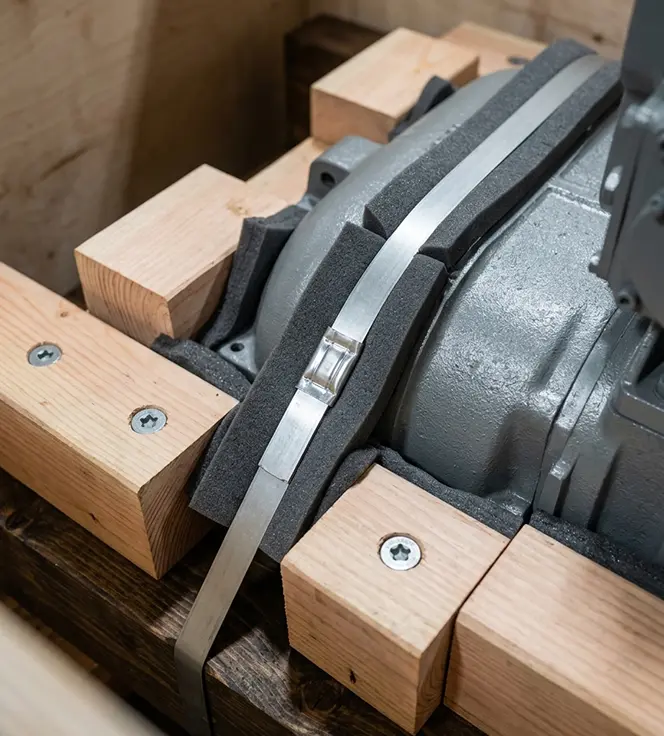
Skids are sized for the forklift and crane capacity at both the origin and the destination, and blocking is bolted or banded to the frame so the load transfers into the crate structure instead of into the machine’s own housing.
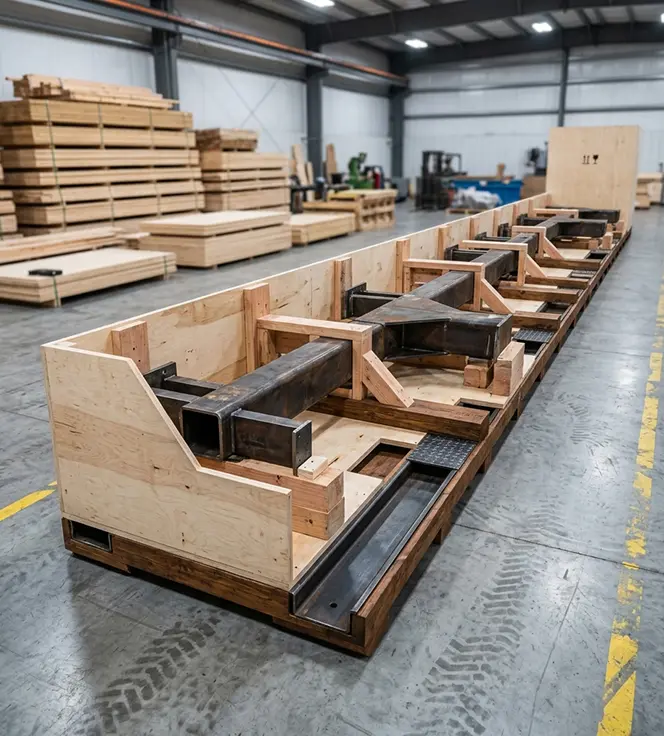
Assemblies that do not fit a rectangle: tanks, frames, long shafts, fabricated structures and anything with parts that stick out. These are built to the actual geometry, with the crate shaped to the asset rather than the asset wedged into a box.
Where the load exceeds standard transport dimensions, the build accounts for how it will be secured on a flatbed or in an open-top container, not just how it sits in the shop.
Equipment leaving a plant for a customer, or components moving between facilities in a production chain. Where the same equipment ships repeatedly, these move to a production crating programme, engineered once and reproduced identically on every order.
For one-off shipments the build is designed, approved by you, and then made. Either way the specification is set before anything is cut.
Clearing a facility or moving a line means multiple assets, a fixed window and usually a hard deadline. Crates can be built in the order the equipment comes out, so the schedule follows the move rather than the other way around.
Where machinery should not travel uncrated even as far as our shop, our crew builds on site with our own forklift. See onsite crating for how that works.
Engineered for
the Handling
Most industrial cargo is not damaged in transit. It is damaged during handling, at the four or five points where a forklift, a crane or a dock crew takes hold of it. That is where a crate either does its job or fails.
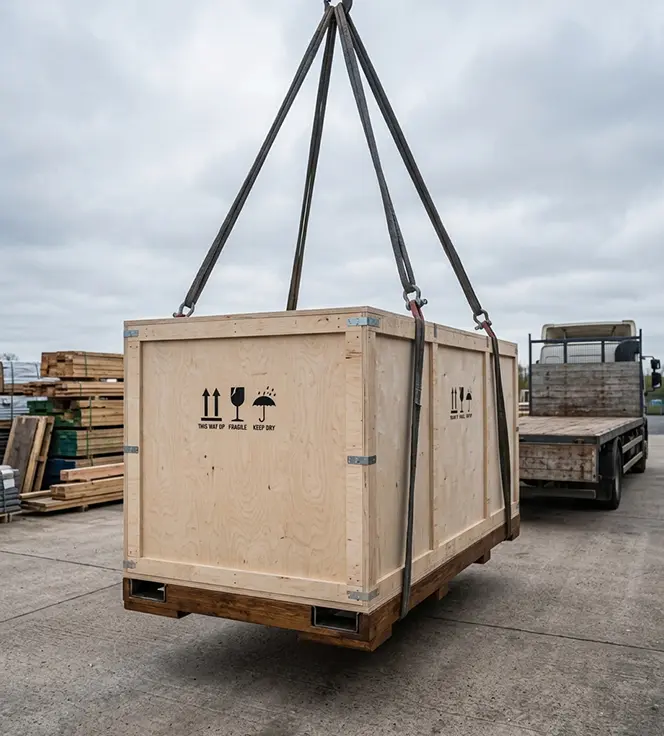
So the skid design comes first: channel width and spacing matched to the forklift, cross members sized for crane lifting, and the load path worked out before the first board is cut. Protective materials and monitoring can be added on top where the asset warrants it, and we will tell you which are worth the cost for your shipment.
- Forklift channels sized to the load
- Cross members rated for crane lifting
- Blocking engineered to the weight
- Handling symbols marked on the crate
Options You
Can Add
Every industrial crate includes the structure, the blocking and the handling design. Beyond that, protection is specified with you based on what the asset is worth, where it is going and how long it will be in transit.
These are quoted as add-ons rather than bundled in by default, so you are not paying for a moisture barrier on a shipment that crosses one province.
- Marvel Seal
- Marine Wrap
- Anti Static
- Anti Shock
- Desiccant Bag
- High Density Foam
- Bubble Wrap
- Tip / Tell & Shock Watch Monitors
Browse our FAQs to find detailed answers to common questions about industrial crating.
Industrial crating is the engineered packaging of heavy machinery, production equipment and oversized assets for transport. It differs from general crating in that the crate has to carry structural load: the skids, blocking and bracing are designed around the asset’s weight distribution and lift points rather than around its outside dimensions.
We build for everything from a few hundred kilograms up to heavy production machinery. The limiting factor is usually not the crate but the handling equipment at each end of the journey, so we ask about forklift and crane capacity at both origin and destination when we quote. Tell us the weight and dimensions and we will tell you what the build needs to look like.
The crate is built to the geometry rather than the asset being forced into a box. For assemblies with protruding parts, long shafts or irregular profiles, the structure is shaped around the actual form, with blocking positioned to support the load at points that can take it. Awkward shapes are normal work for us, not an exception.
Crates are quoted by cubic foot and become more economical as they get larger. Beyond size, the factors that move the price are complexity of the blocking, any protective materials you add, and whether the work happens in our shop or at your facility. Send the product, dimensions, weight and destination and you will typically have a quote within 1 to 2 business days.
Yes. Export builds use heat treated, ISPM-15 stamped lumber tracked through the certification chain, which is what customs authorities require of wood packaging. Wood packaging without a valid stamp can be refused, treated or destroyed at the border at the shipper’s cost. See our export crating service.
Yes. When equipment is bolted down until the day it moves, or is too large to travel unprotected, our crew comes to your facility with materials and our own forklift and builds the crate around the machine where it stands. See our onsite crating service.
Yes. Multi-asset moves are planned around your schedule, with crates built in the order the equipment comes out of the building. Grouping several machines into one job is also more economical than crating them individually, because mobilising a crew is a fixed cost spread across the whole project.
Yes. Where the same equipment travels repeatedly, or ships out and comes back, we design reusable crate systems built to survive multiple cycles rather than a single trip. For closed-loop shipping these usually pay for themselves within a few journeys.
Moisture barriers with desiccant, anti-static materials, high density foam and tip or shock indicators are all available. These are specialist add-ons quoted with the build rather than standard inclusions, so we will walk you through what your shipment actually justifies and price it accordingly.
Send the equipment type, dimensions, weight, destination and whether the work happens at our shop or your site through the quote form below. Photos of the machine in place are genuinely useful. You will typically have a quote with timeline within 1 to 2 business days.