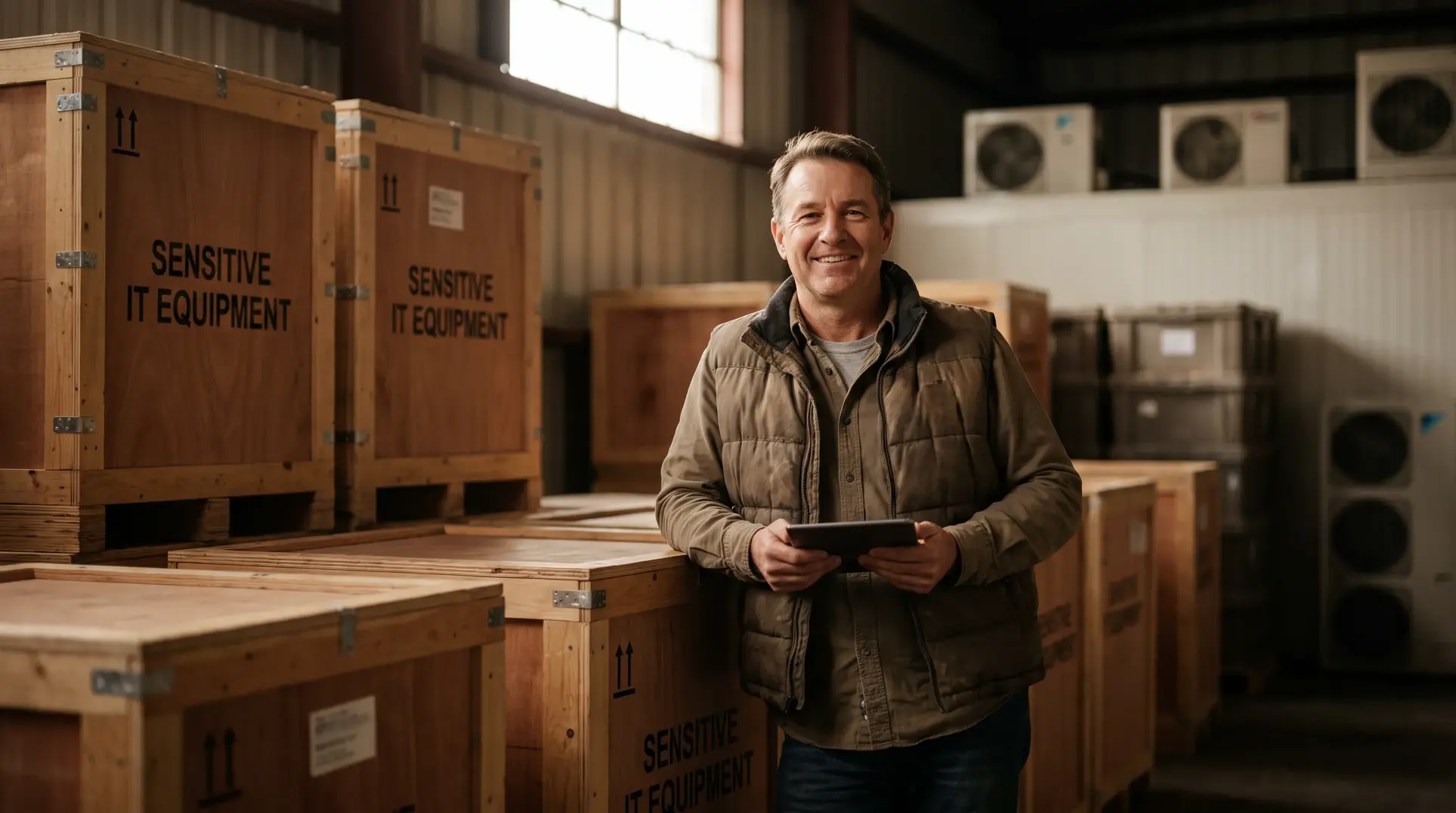
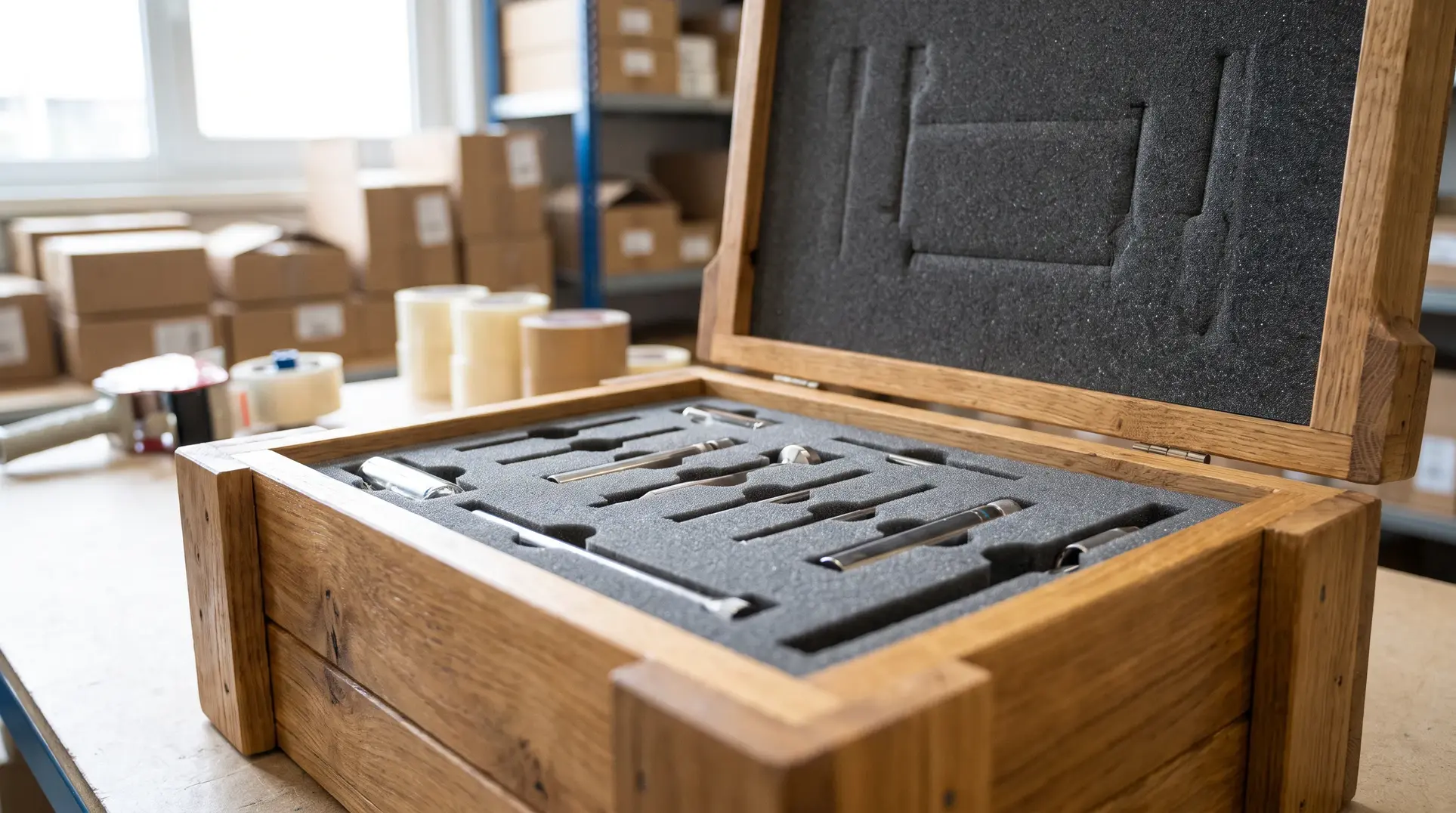
A $1.2 million production line sits idle because the crating crew showed up before the electrician disconnected the controls. Three crates arrived at the new facility, but the foundation contractor is still pouring concrete. The bottleneck machine moved first, and now your entire operation waits while non-critical equipment clogs the loading dock at the destination.
We have seen every version of this story. Plant relocations fail not because the crates were poorly built or the trucks were late. They fail because nobody sequenced the work correctly. The physical move is the easy part. The hard part is coordinating crate fabrication, utility disconnection, production rundown, destination readiness, and staged transport so that your customers never notice the transition.

This checklist is built from the mistakes we have helped clients avoid since 2011. It treats onsite crating services not as a standalone task but as one link in a chain that starts months before the first crate is built and ends only when the relocated equipment passes acceptance testing.
Who This Checklist Is For—and Who It Is Not For
This article is written for operations managers, plant managers, and logistics coordinators responsible for relocating production equipment, test stations, machining centres, or industrial machinery from one facility to another. You ship assets worth six figures. You measure success in production uptime, not just safe delivery. You need a vendor who understands that crating is part of a larger system.
This checklist is not for residential moves, office furniture, or consumer goods. If you are moving file cabinets and desks, any moving company will do. If you are moving a $350,000 CNC machine while maintaining customer supply, keep reading.
Why Onsite Packing Services Are Non-Negotiable for Plant Moves
The alternative to onsite packing services is transporting uncrated machinery to a crating shop. That approach creates three problems:
- Damage risk during the uncrated move. Every transfer, every forklift engagement, every bump in the road exposes precision equipment to shock, vibration, and contamination before any protection is in place.
- Extended production downtime. The machine leaves your floor days or weeks before it arrives at the destination because it must wait at the crating facility for measurement, fabrication, and packing.
- Lost control. Your equipment sits in a third-party location where you cannot monitor handling, cannot coordinate timing, and cannot adjust sequencing on the fly.
Onsite crating brings the crew, materials, tools, and forklifts to your facility floor. The crate is designed around the machine where it sits. Production continues until the final disconnection. The packed asset moves directly from your dock to the transport vehicle with no intermediate handling. According to equipment relocation best practices, eliminating unnecessary handling events is one of the most effective ways to prevent damage during industrial moves.
The Sequencing Principle: Work Outside the Shutdown Window
The fastest relocations are not the ones with the biggest crews. They are the ones where the most work happens before and after the production shutdown.
Think of it this way: every task falls into one of three categories.
- Work you can complete while the machine is still running. Destination foundations, utility installation, crate fabrication, route permits, controls backups, cable labelling, spare-part kits, operator training at the new site.
- Work that requires the machine to be stopped. Lockout/tagout, final cleaning, utility disconnection, dismantling, mounting to the skid, sealing the barrier, closing the crate, extraction, transport, placement, reconnection.
- Work you complete after production resumes. Empty-crate return, final documentation, cosmetic repairs, optimization, old-site clearance.
Your goal is to shrink category two as much as possible. That means crate bases, panels, shipping brackets, and custom saddles are fabricated and inspected before the shutdown date. It means destination utilities are live and tested before the bottleneck machine leaves the origin. It means the warehousing and storage solutions for staged equipment are confirmed, not assumed.
Phase 1: Pre-Move Audit and Measurement (8–12 Weeks Before Move)
Every sequencing failure we have seen traces back to missing information. The crate did not fit because someone measured the machine but forgot the control cabinet. The truck could not access the loading dock because no one surveyed the turning radius. The destination floor could not support the point load because nobody calculated the actual weight distribution.
What the Audit Must Capture
- Asset ID, manufacturer, model, serial number for every piece of equipment
- Operating dimensions versus shipping dimensions (some machines extend during operation)
- Net weight and estimated gross weight with crate and dunnage
- Centre of gravity location and approved lift points
- Utility interfaces: voltage, amperage, phase, air pressure, gas, water, drainage, network
- Fragility rating, vibration sensitivity, and environmental limits
- Hazardous contents: residual fuel, batteries, refrigerants, compressed gas cylinders
- Destination coordinates: exact floor position, anchor points, clearance requirements
Site Survey Checklist
- Door dimensions, corner radii, overhead obstructions at both origin and destination
- Dock access, crane availability, forklift weight limits
- Floor load capacity at staging areas and final positions
- Extraction route from machine position to loading dock
- Weather exposure during loading and unloading
This audit drives everything that follows: crate design, crew sizing, trailer selection, rigging plan, and timeline. Skipping it does not save time. It moves the discovery process into the shutdown window where every hour costs money.
Phase 2: Crate Design and Fabrication (6–8 Weeks Before Move)
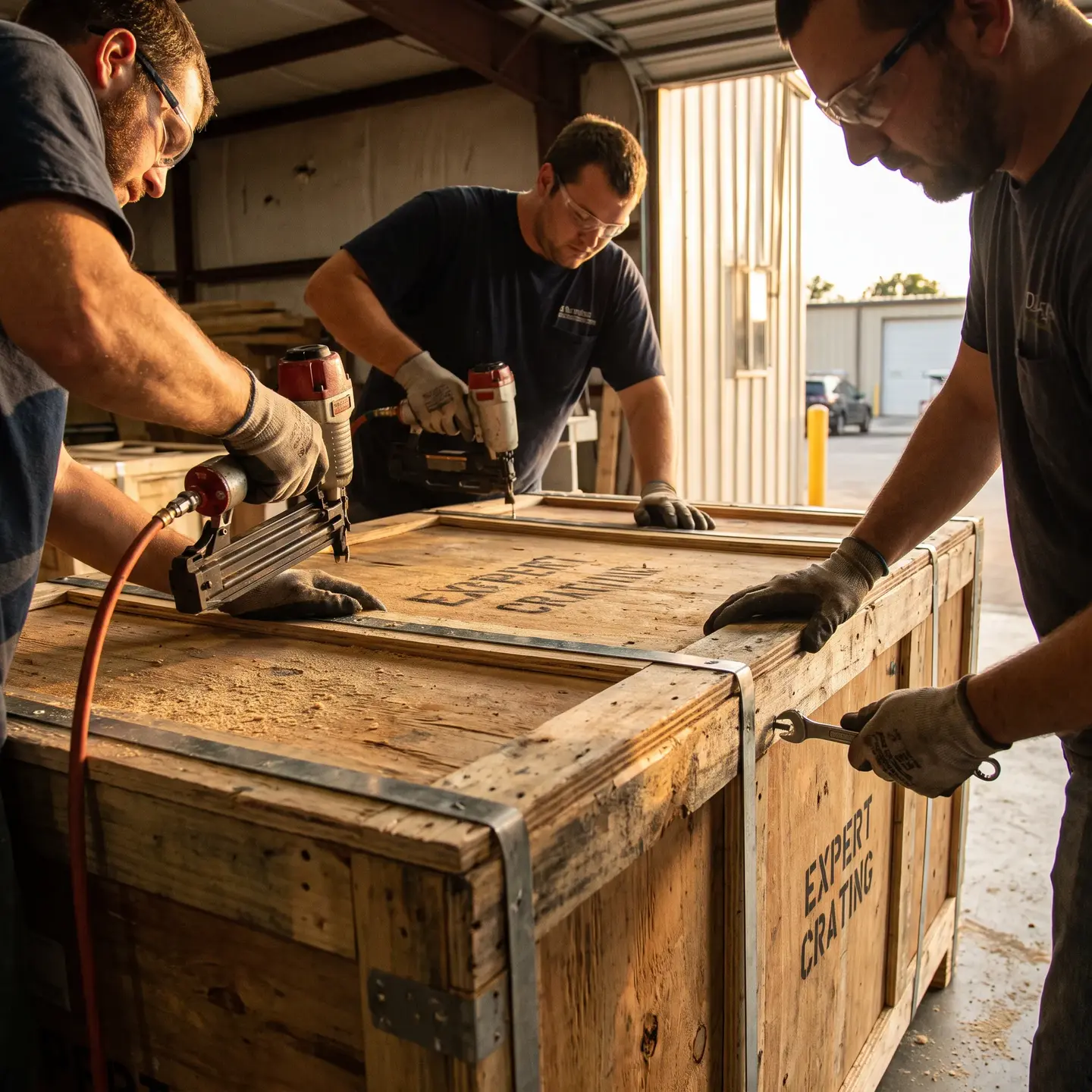
Once the audit is complete, machinery and equipment crating design begins. For a plant relocation, this is not a single crate—it is a system of crates, skids, barriers, and accessories that must integrate with the installation sequence at the destination.
Design Inputs
- Machine support points and load-bearing structure
- Required cushioning or vibration isolation based on route hazards
- Moisture protection requirements for transport duration and climate
- Lift and handling constraints: forklift pocket spacing, minimum fork length, crane pick points
- Destination unloading sequence: which crate must come off first?
Fabrication and Inspection
Crate bases, panels, and hardware are built, trial-fitted where critical, and inspected before the shutdown date. Treated timber status is verified if the move crosses international borders. For export shipments, the ISPM 15 wood packaging standards require heat treatment, debarking, and the official IPPC mark on all solid wood packaging materials.
The key point: fabrication happens before shutdown. If the crate is not ready when the machine is, the machine sits on your floor waiting—and production has already stopped.
Phase 3: Destination Readiness Verification (4–6 Weeks Before Move)
The most common cause of extended downtime in plant relocations is not the transport. It is the destination. A machine arrives on time, but the electrical contractor is not finished. The foundation has not cured. The compressed air system is still being tested. The IT team has not configured the network ports.
Destination Readiness Checklist
- Foundations and anchors: Complete, cured, and surveyed for position accuracy
- Electrical supply: Live, tested for correct voltage, frequency, phase rotation, and grounding
- Utilities: Compressed air, gases, water, steam, drainage—all tested at required pressures and flow rates
- HVAC and environmental controls: Operating within specification for equipment requirements
- Network infrastructure: OT network ports configured and tested
- Rigging access: Overhead crane operational, floor path cleared, staging area prepared
If any critical prerequisite is incomplete, the shutdown date should move or the bottleneck machine should not ship. There is no value in delivering a $280,000 test station to a building where it cannot be energized.
Phase 4: Sequencing Strategy—Which Equipment Moves When
This is where most relocation plans fail. Someone decides to “move everything at once” or picks the order based on convenience rather than operational logic.
Classification Framework
- Bottleneck equipment: The machine that limits your output. This moves last. It stays operational at the origin until the destination is proven, the upstream and downstream equipment is installed, and the operators are trained.
- Duplicate or redundant equipment: Assets where you have backup capacity. These move first. They serve as your pilot wave, testing the crating, transport, and installation process before you commit the critical path.
- Independent equipment: Machines with no direct process dependency. These can move in any order without affecting production.
- Shared resources: Tooling, inspection equipment, material handling—schedule these based on when they are needed at each site.
Staged Pickup Coordination
For a complex move, staged pickups over several days or weeks maintain production continuity. The sequence follows this logic:
- Week 1: Non-critical storage equipment, archived materials, redundant fixtures
- Week 2–3: Duplicate machines, secondary production lines, support equipment
- Week 4: Primary production equipment in reverse dependency order
- Final days: Bottleneck equipment, only after destination acceptance testing on earlier arrivals
Each wave informs the next. If the pilot wave reveals crate handling problems, transport delays, or destination issues, you fix them before the critical equipment moves.
Phase 5: Crate-in-Place Execution
The onsite crating crew arrives with materials, tools, forklifts, and the pre-fabricated crate components. Here is the execution sequence:
- Final pre-crating inspection: Verify machine matches the audit documentation. Photograph existing condition. Record any new damage or changes.
- Coordinate shutdown: Work with facility electrician for lockout/tagout. Verify zero-energy state before any crating work begins.
- Disconnect and match-mark: Label both ends of every cable, hose, and pipe. Photograph terminal blocks and connector orientation. Bag fasteners by assembly.
- Prepare the machine: Lock moving axes, spindles, doors, robot joints. Remove or secure loose tooling. Cap open ports. Apply corrosion protection to vulnerable surfaces.
- Mount to skid: Position the pre-fabricated base. Bolt the machine through approved mounting points. Add chocks, saddles, and blocking.
- Install moisture barrier: For humid, ocean, or long-storage routes, seal the machine in a vapor barrier with calculated desiccant and humidity indicator.
- Close and mark the crate: Verify all loose components against the packing list. Close panels. Apply weight, handling, and orientation markings.
- Load to transport: Forklift engagement at approved pocket locations. Secure to trailer or container with structural tie-downs.
The entire sequence can happen in hours for a single machine or across multiple days for a production line. The key is that production continues on other equipment until each machine reaches its shutdown point in the schedule.
Phase 6: Storage Buffer for Phased Installation
Not every relocation moves equipment directly from origin to final position. Sometimes the destination installation is phased. Sometimes the new facility is not ready for all equipment at once. Sometimes weather or permits delay transport.
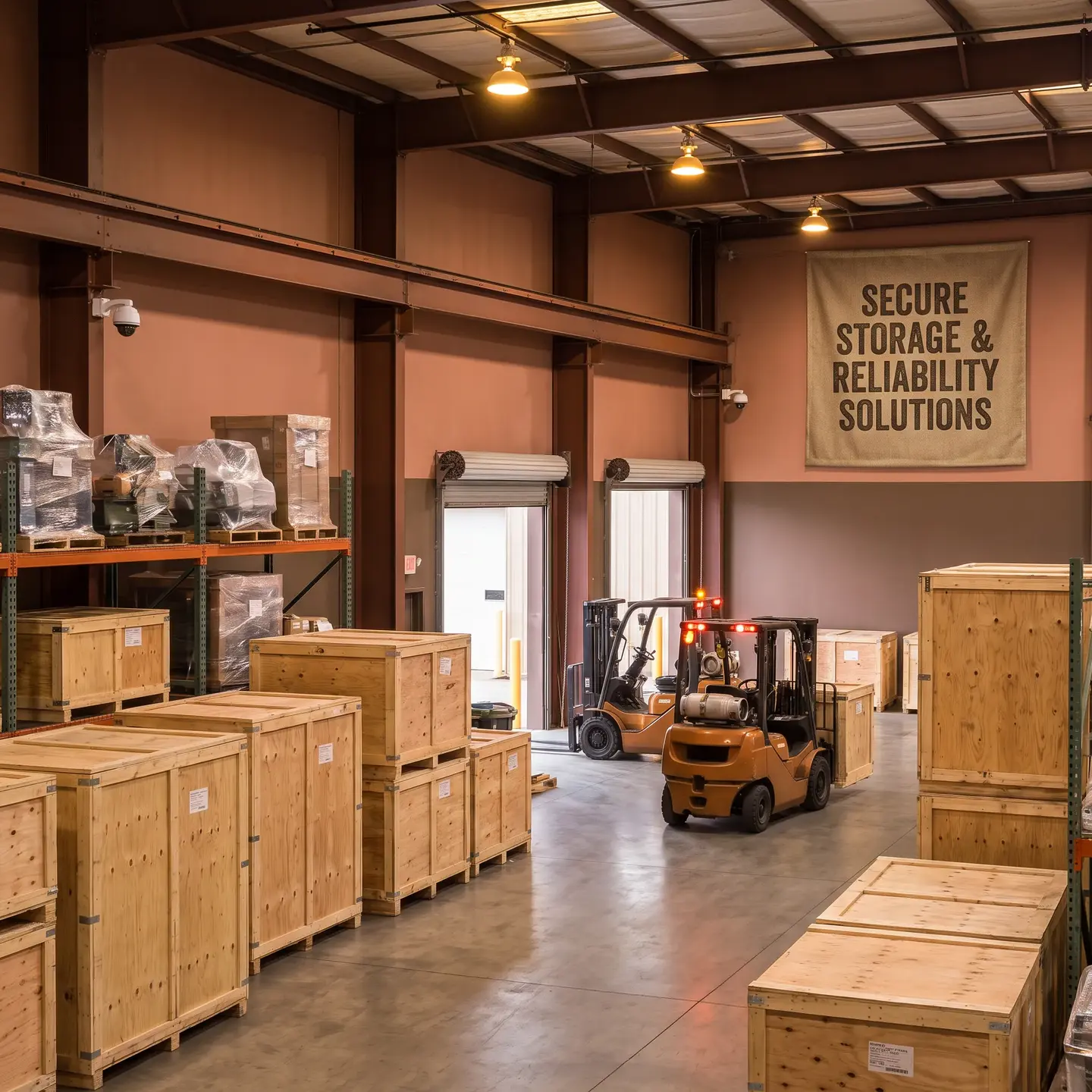
A storage buffer absorbs these timing mismatches. Crated equipment arrives at a secure warehouse facility, remains protected, and ships to the destination on the installation schedule rather than the crating schedule.
Storage Considerations
- Climate control: For electronics, optics, or corrosion-sensitive equipment, temperature and humidity control prevents damage during the interim period
- Inventory management: Track every crate, know its contents, and maintain the unloading sequence even when crates are stored out of order
- Barrier monitoring: For long storage periods, inspect humidity indicators and desiccant condition periodically
- Access and handling: The warehouse must have the forklift capacity and floor space to receive, stage, and dispatch industrial crates without damage
November Timing: Pre-Winter Relocation Urgency
If you are reading this in fall, you already know the pressure. Snow, ice, and extreme cold complicate every element of a plant relocation:
- Transport delays: Winter storms close highways. Trucks miss windows. Container ships slow down.
- Loading dock access: Ice and snow accumulation restricts forklift movement and trailer positioning.
- Temperature exposure: Electronic controls, hydraulic systems, and precision instruments can be damaged by freeze-thaw cycles during loading and unloading.
- Contractor availability: HVAC, electrical, and foundation contractors prioritize emergency work over scheduled projects when winter hits.
For companies targeting completion before winter, the booking window for onsite packing services industrial is closing. Crews, materials, and transport capacity fill up as everyone rushes to beat the weather. Start the audit now. Lock in fabrication dates. Prove destination readiness before the first snow.
The Complete Plant Relocation Checklist
8–12 Weeks Before Move
- Complete equipment audit with dimensions, weights, and utility requirements
- Conduct origin and destination site surveys
- Identify equipment sequencing: bottleneck last, pilot wave first
- Select crating, rigging, and transport vendors
- Confirm destination infrastructure timeline
- Establish inventory bridge or alternate production capacity
4–8 Weeks Before Move
- Approve crate designs and bill of materials
- Begin crate fabrication
- Verify ISPM 15 compliance for export shipments
- Back up all PLC, HMI, robot, and CNC configurations
- Schedule onsite crew dates and forklift availability
- Confirm storage buffer if destination is phased
2–4 Weeks Before Move
- Conduct pre-move walkthrough with crating crew
- Finalize daily sequencing schedule
- Verify destination utility-readiness certificates
- Stage move kits: tools, fasteners, labels, preservation materials
- Run pilot wave if using duplicate equipment
- Brief facility staff on shutdown procedures and coordination points
1 Week Before Move
- Confirm go/no-go checklist: destination ready, crates ready, transport booked, crew scheduled
- Prepare staging areas at origin and destination
- Finalize equipment shutdown sequence with operations and maintenance
- Pre-position rigging equipment and material handling resources
Move Week
- Daily coordination calls: crating crew, transport, destination receiving
- Execute crate-in-place sequence per schedule
- Document condition at every handoff: photos, seal numbers, weight records
- Verify shock indicators and humidity cards before closing containers
- Hold receiving inspection before signing clean delivery receipts
Post-Move
- Unpack under controlled conditions with component reconciliation
- Commission progressively: static inspection, jog test, no-load cycle, full-rate trial
- Compare performance to pre-move baseline
- Close punch items and update maintenance records
- Return or dispose of crate materials
- Document lessons learned for future relocations
What Happens When You Get the Sequence Wrong
The financial stakes are real. Industry research estimates that the world’s largest companies lose nearly eleven percent of revenue to unplanned downtime. The median cost of an industrial outage exceeds $125,000 per hour. A plant relocation is a planned event, but poor sequencing turns it into an unplanned one—extended by days or weeks while you wait for crates, utilities, contractors, or customs clearance.
The equipment damage is often invisible. A test station that arrived “fine” may show calibration drift three months later because nobody noticed the shock indicator was triggered. A machining centre with no visible damage may have bearing wear from an unlocked spindle during transport. By the time the problem appears, the evidence is gone and the warranty argument begins.
Request a Pre-Move Facility Audit
If you are planning a facility relocation and need onsite packing services that integrate with your production schedule, we can help. Our team conducts the initial audit, designs crates around your equipment specifications, fabricates before your shutdown window, and executes the crate-in-place work with our own crews and forklifts.
As a Controlled Goods Program registered, ISPM-15 certified crating provider, we handle defence, aerospace, high-tech, and manufacturing equipment across the Montreal to Toronto corridor. Request a quote to start the conversation about your relocation timeline.
Frequently Asked Questions
Why should we use onsite crating instead of moving machinery to a crating facility?
We use onsite crating to eliminate unnecessary handling before protection is installed. Moving uncrated equipment to a separate facility exposes precision machinery to shock, vibration, contamination, and additional forklift transfers. It also creates avoidable downtime because the machine leaves production before its crate is ready. By fabricating the crate beside the equipment, we can protect it immediately after disconnection and move it directly to the transport vehicle with better control over timing and handling.
How far in advance should we begin planning a plant relocation?
We recommend beginning the audit 8–12 weeks before the planned move. During this stage, we document dimensions, weights, lift points, utilities, centre of gravity, hazards, and site access. Crate design and fabrication should begin 6–8 weeks before the move, while destination readiness should be verified 4–6 weeks ahead. This schedule gives us time to correct missing information before shutdown, when every delay can affect production.
Which equipment should move first, and which machine should move last?
We move redundant or non-critical equipment first because it provides a low-risk pilot wave. This lets us test crating, transport, receiving, and installation before moving critical assets. Bottleneck equipment should move last. We keep it operating at the original facility until the destination is ready, earlier equipment has passed acceptance testing, and operators are prepared. This sequence protects production capacity and prevents one delayed machine from stopping the entire operation.
What must be ready at the destination before we ship critical equipment?
We verify that foundations are complete, cured, and accurately surveyed before shipment. Electrical service must be live and tested for voltage, frequency, phase rotation, and grounding. Compressed air, gases, water, steam, drainage, HVAC, and network connections must also meet the machine’s requirements. We confirm crane access, floor paths, and staging space. If a critical prerequisite is incomplete, we delay shipment rather than deliver valuable equipment that cannot be installed or energized.
When do we need a storage buffer during a phased relocation?
We use a storage buffer when the destination cannot receive every crate immediately, installation occurs in stages, or transport timing does not match construction progress. Crated equipment can remain protected while the facility catches up. For electronics, optics, and corrosion-sensitive machinery, we specify climate-controlled storage and monitor humidity indicators and desiccant. We also maintain crate identification and unloading sequence records, so equipment can be dispatched in the correct installation order without unnecessary handling.