A $280,000 test station arrives at your customer’s facility in Munich. The receiving team opens the crate, finds the equipment shifted inside its foam nest, and discovers corrosion spots on exposed metal surfaces. Now you face warranty claims, repair costs, and a customer who will think twice before ordering again. The question that matters is not whether damage occurred—that much is obvious. The question is: can you prove what happened during transit, and can you prove your packaging did its job?
We build crates that answer both questions. At our Ottawa shop, we integrate tip indicators, impact sensors, moisture barriers, and engineered foam systems into a unified protection architecture. These technologies do more than cushion your cargo. They create a verifiable record of handling conditions from the moment the crate leaves your dock until it reaches final delivery. When something goes wrong, you have evidence. When everything goes right, you have proof.
This article explains how each protection layer works, what the monitoring devices reveal about handling quality, and what your receiving teams should check when a crate arrives.
Who This Article Is For
This content serves logistics coordinators, procurement officers, and operations managers at companies shipping high-value equipment—servers, test stations, drones, HVAC units, precision machinery—who need documented proof that their cargo was handled correctly. If you ship assets worth five or six figures and face hard questions when damage occurs, this applies to you.
This article is not for consumer shipping, residential moving, or general freight. We focus on engineered protection systems for industrial and technical cargo where damage has measurable business consequences.
Understanding Shock-Absorbing Packaging Systems
Shock-absorbing packaging in professional crating goes far beyond bubble wrap and packing peanuts. We engineer foam systems that absorb and disperse impact forces across drops, vibrations, and collisions throughout multimodal transit. The goal is reducing the G-forces your cargo experiences to levels below its fragility threshold.
Why Fragility Thresholds Matter
Every piece of equipment has a fragility level—the maximum force its structure can withstand before damage occurs, expressed in G’s. A precision test station might tolerate 15G before internal alignment shifts. A ruggedized server rack might handle 40G. A calibrated sensor assembly might fail at 5G.
We match foam density, thickness, and configuration to your cargo’s specific fragility requirements. This is not guesswork. Foam selection follows established testing protocols, including those outlined in ASTM D4169 shipping container testing standards and International Safe Transit Association testing protocols.
How Engineered Foam Works
Closed-cell polyethylene and polyurethane foams compress under impact, converting kinetic energy into heat and distributing forces across a wider area. The foam then recovers its shape, ready to absorb the next shock event. Key variables include:
- Foam density: Higher density foams support heavier loads but transmit more vibration. Lower density foams cushion better but bottom out under weight.
- Foam thickness: Thicker foam provides longer deceleration distance, reducing peak G-forces during drops.
- Foam geometry: Custom-cut cavities cradle your equipment, preventing shifting while isolating it from crate walls where impacts concentrate.
We calculate foam specifications based on your equipment’s weight, centre of gravity, and fragility rating. A 200-pound server with a 25G fragility threshold requires different foam configuration than a 50-pound calibration instrument rated at 10G. Our custom crate engineering services include this analysis as standard practice.
Tip Indicators: Proving Orientation Compliance
Some cargo cannot be tipped, tilted, or inverted without damage. Vertical test equipment, liquid-filled systems, and asymmetrically loaded machinery must travel upright. Printed arrows and “This Way Up” labels tell handlers what to do. Tip indicators prove whether they did it.
How Tip Indicators Work
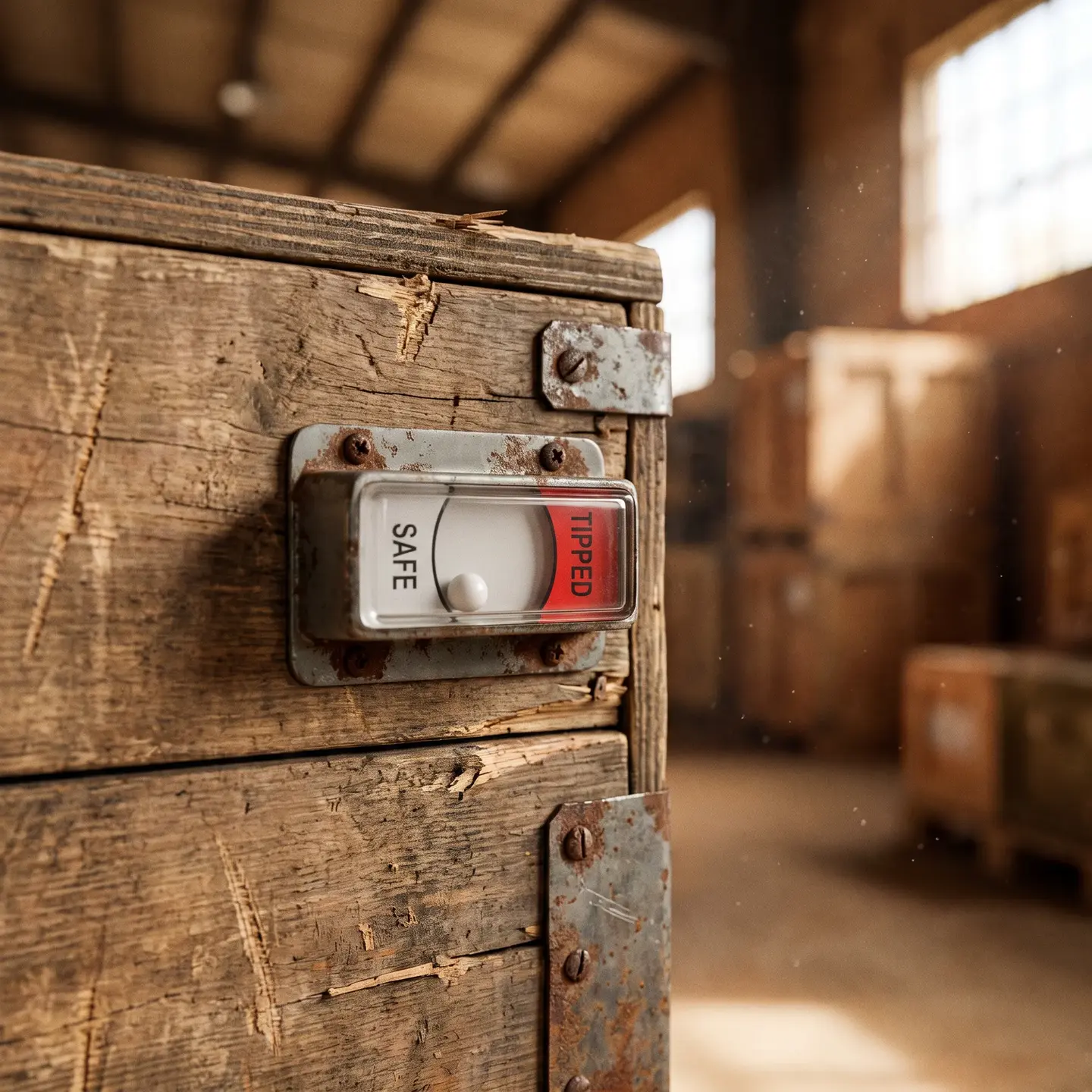
Devices like TiltWatch XTR contain a precision-engineered mechanical pathway—typically a stainless steel ball in a sealed housing. When the crate tips beyond a set angle (commonly 80° from vertical), the ball moves into a visible window and cannot return. The indicator changes from clear to red, creating permanent, tamper-proof evidence of a tipping event.
More detailed indicators like TiltWatch Plus provide graduated readings. They activate at 30° and display tilt angles in 10° increments up to 90°, showing not just that tipping occurred but how severe it was. Three separate windows document left tilt, right tilt, and complete overturn.
Placement and Interpretation
We mount tip indicators on the narrowest side of the crate, aligned with the most likely tipping axis. For full coverage, two indicators on adjacent sides monitor all tilting planes. Placement near a bottom corner ensures the indicator experiences the same forces as the cargo.
What receivers should check:
- Indicator window colour: Clear or white means the crate stayed upright. Red means tipping exceeded the threshold.
- Indicator presence: A missing indicator suggests tampering or removal after activation.
- Documentation: Record indicator status on the delivery receipt before signing. Note the indicator’s unique ID number if visible.
An activated tip indicator does not automatically mean damage occurred—it means inspection is required. The indicator triggers investigation, not rejection.
Impact Sensors: Documenting G-Force Events
Tip indicators capture orientation problems. Impact sensors capture shock events—drops, collisions, and rough handling that generate forces exceeding your cargo’s tolerances.
How Impact Sensors Work
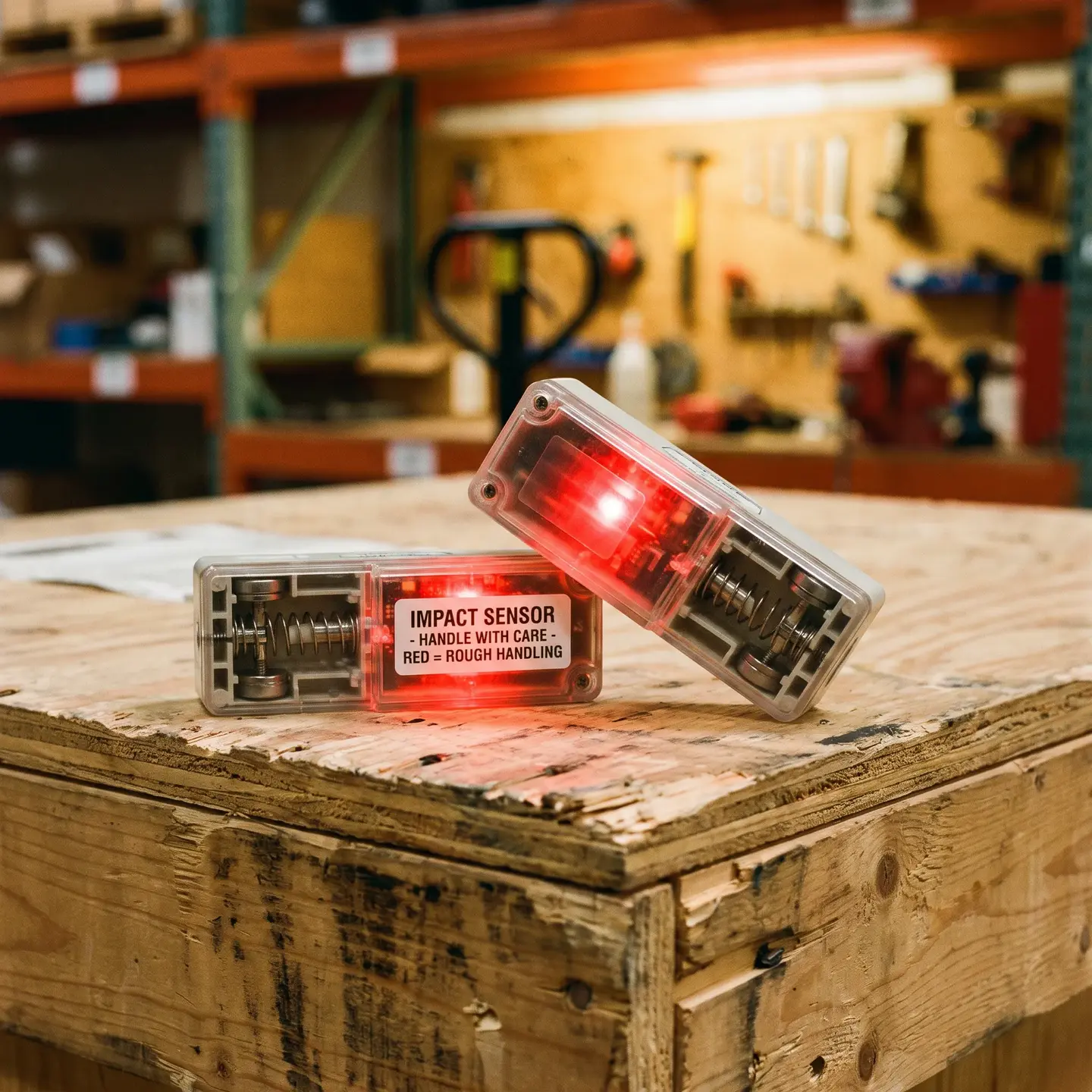
Mechanical impact indicators like ShockWatch contain a tube with coloured liquid suspended in a calibrated housing. When the crate experiences acceleration beyond a preset threshold (commonly between 5G and 75G), the liquid releases and turns a window bright red. The change is permanent and tamper-evident.
More sophisticated impact recorders continuously monitor shock and vibration, recording direction, amplitude, and duration of force events. These devices provide detailed profiles that correlate specific handling events with potential damage.
Matching Sensitivity to Cargo
We select impact sensor thresholds based on your equipment’s fragility rating. A precision optical assembly rated at 10G gets indicators set below that threshold. A ruggedized server rack rated at 50G gets higher-threshold sensors to avoid false activation from normal handling.
Placement matters. We mount impact indicators on opposite sides of the crate so that impacts from any direction are captured. If the crate drops on corner A, the indicator on side B still registers the shock event.
What Activated Indicators Mean
A red impact indicator tells you the crate experienced forces above the preset threshold. It does not tell you whether damage occurred—that requires inspection. What it provides is:
- Evidence for claims: Carrier disputes become simpler when you have tamper-proof documentation of mishandling.
- Accountability: Handlers who know shipments are monitored adjust their behaviour accordingly.
- Inspection triggers: Activated indicators prioritize which crates need immediate examination.
Industry experience shows that structured impact indicator programs reduce damage rates by 40–60 percent, largely because visible monitoring deters mishandling before it occurs.
Moisture Barriers and Desiccant Systems
Shock and tilt are not the only threats during transit. Ocean containers experience daily temperature cycles that drive condensation—warm, humid air contacts cold steel ceilings, and water drips onto cargo below. Container rain, as it is called, causes rust, corrosion, electrical failures, and carton collapse.
The Barrier-Desiccant Approach
Moisture protection requires two complementary systems:
- Barrier films: Aluminium foil or high-grade polymer laminates create a sealed envelope around your equipment, limiting water vapour transmission from outside the package.
- Desiccant packets: Silica gel or calcium chloride absorbs residual moisture trapped inside the sealed volume and any moisture that enters through small permeations over time.
We size desiccant quantities based on free volume inside the barrier, expected sealed duration (including plant storage, terminal dwell, ocean weeks, and destination warehouse time), and climate intensity of the route. A crate bound for Hamburg in winter requires different moisture management than one shipping to Singapore in monsoon season.
Vapour Corrosion Inhibitors
For bare metal surfaces, we add vapour corrosion inhibitor (VCI) films or papers inside the barrier envelope. VCI materials release corrosion-inhibiting molecules that adsorb onto metal surfaces, forming a protective layer against oxidation. This is particularly important for machined surfaces, unpainted steel components, and electrical contacts.
Humidity Indicator Cards
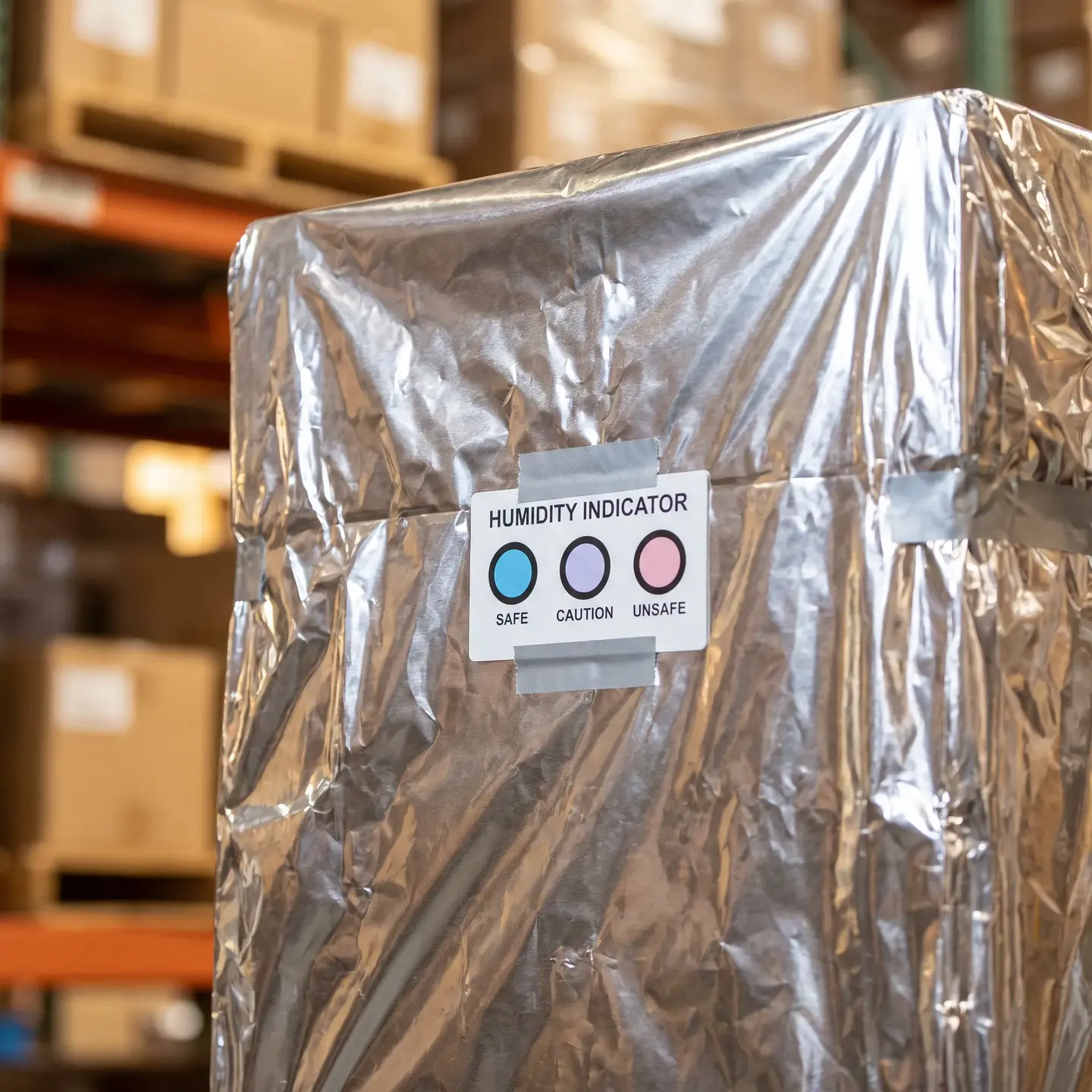
Inside the barrier volume, we include humidity indicator cards with colour-changing spots calibrated to specific relative humidity thresholds. When receivers open the barrier, they can verify at a glance whether internal humidity stayed within safe limits throughout transit.
What receivers should check:
- Barrier integrity: Look for tears, punctures, or failed seams in the moisture barrier film.
- Indicator card colour: Compare spot colours to the printed scale. Pink or red spots at lower humidity thresholds indicate moisture intrusion.
- Desiccant saturation: Some desiccant packets include colour indicators showing saturation level.
Engineered Foam Protection: Beyond Generic Cushioning
Generic foam padding protects against generic threats. Custom-engineered foam systems protect against the specific forces your specific cargo will encounter on its specific route.
Foam Density Selection
We select foam density based on static load requirements. Too soft, and the foam bottoms out under the equipment’s weight, eliminating cushioning capacity before any shock event occurs. Too firm, and the foam transmits vibration directly to the cargo. The correct density supports your equipment’s weight while maintaining reserve compression capacity for impacts.
Custom Cavity Design
We cut foam cavities to match your equipment’s geometry precisely. The cavity cradles the cargo, distributing contact pressure across maximum surface area while preventing lateral movement. Recessed areas accommodate protrusions, handles, and fragile components. The foam geometry works with the crate structure to create a complete suspension system.
Layered Protection
For highly fragile cargo, we layer different foam densities:
- Soft inner layer: Provides cushioning against minor vibrations and small impacts.
- Firmer outer layer: Handles major shock events and prevents the inner layer from bottoming out.
- Rigid blocking: Prevents lateral shifting and controls load position within the crate.
This layered approach addresses different frequencies and force magnitudes that cargo encounters across truck, rail, air, and ocean transport. Each mode generates different vibration frequencies—truck freight varies between 2–70 Hz depending on road conditions and tire quality, while aircraft cargo floors can reach 2,000 Hz.
What to Inspect Upon Crate Arrival: A Receiver’s Checklist
Protection systems only deliver value if receivers know what to check. Train your goods-in teams to inspect systematically before signing delivery receipts.
Exterior Inspection
- Crate structure: Look for cracks, broken boards, separated joints, and evidence of impact damage.
- Tip indicators: Check all indicator windows. Note colour and unique ID numbers.
- Impact sensors: Check all sensor windows. Note colour and threshold rating.
- Markings: Verify handling labels match crate orientation (arrows pointing up, correct side down).
If Indicators Show Mishandling
- Do not refuse the shipment. Refusal complicates claims and leaves you without evidence.
- Document indicator status on the delivery receipt. Include date, time, indicator colour, and your signature.
- Obtain the driver’s signature acknowledging the notation. Documentation without carrier acknowledgment may lack legal weight.
- Photograph everything: exterior damage, indicator states, markings, and any visible interior damage before disturbing the contents.
- Notify the shipper within 48 hours with indicator status, photos, and delivery documentation.
Interior Inspection
- Barrier condition: Check moisture barrier for tears or punctures before opening.
- Humidity indicator: Read humidity indicator card immediately upon opening the barrier.
- Foam position: Verify equipment sits properly in its foam cavity without shifting or displacement.
- Equipment condition: Inspect for visible damage, corrosion, or moisture marks.
How Multiple Protection Layers Work Together
No single technology solves every problem. Foam absorbs shock but does not prevent tipping. Barriers control moisture but do not cushion impacts. Indicators document events but do not prevent them. Effective crate engineering integrates all layers into a system where each component addresses specific threats while supporting the others.
The Protection Stack
- Structural crate: Weather shell, stacking resistance, lift points, and handling interface.
- Moisture management: Barrier envelope, desiccant, VCI films, humidity indicators.
- Shock absorption: Engineered foam, blocking, bracing, suspension design.
- Handling verification: Tip indicators, impact sensors, tamper-evident seals.
- Documentation: Packing lists, indicator ID numbers, inspection records.
When we design a crate, we size each layer to the specific cargo, route, and risk profile. A server shipping to Toronto gets different protection than the same server shipping to Taiwan. A one-time shipment gets different documentation than a recurring production run with established procedures.
Why Redundancy Matters
Redundant protection acknowledges that transit conditions vary beyond prediction. The route that worked fine last month might involve a different carrier, different equipment, or different weather this month. Multiple protection layers ensure that when one system encounters conditions beyond its design—humidity spikes past desiccant capacity, impacts exceed foam specification—other layers provide backup protection and documentation continues regardless.
From Protection to Proof
We build crates that protect your equipment. More importantly, we build crates that prove your equipment was protected. Tip indicators, impact sensors, and humidity cards create an evidence chain that survives the journey from your loading dock to your customer’s receiving bay.
When the crate arrives intact and all indicators show proper handling, you have documented proof that your shipping standards met the journey’s demands. When indicators show problems, you have evidence for carrier accountability and claims processes. Either way, you know what happened to your cargo—not as speculation, but as verifiable fact.
That is what separates engineered protection from commodity packaging. The box does not just survive transit. The box tells you how it survived.
Frequently Asked Questions
How can we prove whether a crate was tipped during transit?
We use tip indicators mounted on the crate’s likely tipping axes. Devices such as TiltWatch XTR turn red when the crate exceeds an approximately 80-degree tilt and remain permanently activated. At delivery, we record the indicator colour, unique identification number, and condition on the receipt. An activated indicator does not prove equipment damage, but it provides objective evidence that the shipment requires immediate inspection and documentation.
What does an impact sensor tell us about shipping damage?
An impact sensor shows whether the crate experienced a shock above its preset G-force threshold. We select that threshold according to the equipment’s fragility rating, such as 10G for a precision optical assembly or 50G for a ruggedized server rack. A red sensor does not confirm internal damage. It identifies a handling event, allowing us to prioritize inspection, photograph the evidence, and support a carrier claim.
Why is custom-engineered foam better than generic packing material?
We design foam around the equipment’s weight, centre of gravity, geometry, and fragility threshold. Correct density supports the static load without bottoming out, while sufficient thickness provides distance to slow an impact. Custom cavities prevent lateral movement and keep fragile components away from crate walls. Generic foam may cushion minor contact, but it cannot reliably manage the different shock and vibration conditions created by truck, rail, air, and ocean transport.
How do we prevent corrosion during long-distance or ocean shipping?
We combine a sealed aluminium or polymer moisture barrier with correctly sized desiccant. The barrier limits water-vapour entry, while silica gel or calcium chloride absorbs residual moisture inside the sealed volume. For exposed steel, machined surfaces, and electrical contacts, we can add vapour corrosion inhibitor film or paper. A humidity indicator card provides visual evidence of internal conditions when the barrier is opened, but it does not replace the desiccant.
What should our receiving team do if an indicator is activated?
We recommend accepting the shipment with an exception noted rather than refusing it immediately. The receiver should record the indicator status, threshold, date, time, and identification number on the delivery receipt, obtain the driver’s acknowledgment, and photograph the crate and indicators. Before disturbing the contents, document exterior damage. Then inspect the moisture barrier, humidity card, foam position, and equipment for corrosion or visible damage, and notify the shipper within 48 hours.