A $350,000 test station sits on your shipping dock. The freight cost alone runs $7,000. One mishandled transfer, one unexpected shock during air transit, one humidity spike in a container hold, and you are shipping it right back for recalibration or repair while your production line waits. We have seen this scenario play out too many times, and we have spent the last fourteen years building crates specifically to prevent it.
Test stations and laboratory instruments are not ordinary cargo. They combine heavy frames with delicate internals: precision sensors, optical assemblies, micro-positioning stages, and calibrated measurement systems that drift out of spec from forces you would never feel walking across a room. Standard freight packaging treats every box the same way. Custom crating for test equipment starts from what can go wrong and works backward to prevent it.
Who This Article Is For
This article is written for procurement officers, logistics coordinators, and operations managers at companies that ship calibrated test equipment, measurement instruments, or laboratory systems. If you are moving a universal testing machine, an environmental chamber, a semiconductor test station, or any instrument where damage means weeks of downtime and five-figure repair bills, keep reading.
This article is not for companies shipping consumer goods, retail inventory, or general manufacturing parts. If your cargo can survive a few bumps without consequences, standard packaging serves you fine. We are focused here on equipment where the stakes justify engineered protection.
The True Cost of Test Equipment Damage
The replacement cost of the instrument is only the starting point. When a six-figure test station arrives with calibration drift or physical damage, the real costs multiply:
- Project delays: Production testing stops until the equipment is repaired or replaced. Depending on your operation, that can mean missed customer commitments and penalty clauses.
- Recalibration time: Even if the damage looks minor, precision instruments require recalibration to NIST calibration and measurement guidelines or equivalent standards. That process takes days or weeks, not hours.
- Shipping round-trip: You paid $7,000 to send it. You will pay another $7,000 to send it back for repair. Then another $7,000 to receive the repaired unit. That is $21,000 in freight before you count the repair itself.
- Insurance complications: Without documented evidence of handling conditions during transit, claims become difficult to prove. Carriers push back. Adjusters delay. Your cash flow suffers.
Test equipment is uniquely vulnerable because its value lies in precision, not durability. A universal testing machine looks solid, but its load cell can drift from a single hard impact. An environmental chamber might survive a drop, but its temperature controls may never hold specification again. Spectroscopy equipment contains optical paths aligned to tolerances measured in microns. These are not rugged industrial tools. They are precision instruments that happen to weigh hundreds or thousands of pounds.
Why Standard Freight Packaging Fails for Test Stations
Generic freight packaging follows a simple logic: wrap it, pad the corners, strap it to a pallet, and hope for the best. That approach fails precision instruments in several specific ways:
Inadequate Shock Isolation
Standard foam padding absorbs some impact energy, but it does not isolate the equipment from the full frequency range of transit vibrations. Road transport produces sustained low-frequency vibrations over hours or days. Air cargo generates short, high-g shocks during loading and turbulence. Ocean freight adds rolling and pitching that shifts loads in ways land-based handlers never anticipate. A test station with sensitive sensors needs isolation tuned to its specific mass and resonant frequencies, not a generic foam blanket.
No Moisture Control
Electronics and precision components corrode when humidity rises. Ocean containers and cargo holds experience temperature swings that cause condensation inside packaging. Standard cardboard and foam offer no moisture barrier. A test station that leaves your facility in perfect condition can arrive with corrosion on connectors and boards, damage that may not show up until weeks later when intermittent faults start appearing.
Improper Weight Distribution
Test stations often have uneven mass distribution: heavy frames on one side, delicate instrumentation on the other. Standard pallet strapping treats the load as a uniform block. When the crate tips during handling, all that mass shifts to whatever the strap was holding in place, creating stress concentrations that crack frames and bend precision assemblies.
No Documentation for Claims
When damage occurs and you need to file a claim, the carrier will ask for evidence. What was the condition of the crate at pickup? What shocks occurred during transit? What was the humidity inside the packaging? Without shock indicators, tilt monitors, and documented packing protocols, you have no evidence. The claim becomes your word against theirs.
Engineering Approach to Test Equipment Crating
At AML, we build crates for test equipment using an engineering process that addresses each of these failure modes. Our custom crating services start from the equipment’s specific vulnerabilities and build protection around them.
3D Design and Digital Modeling
Before we cut any wood, we model the equipment and the crate digitally. This allows us to map contact points and stress zones, identify where the mass concentrates, and design blocking that distributes load through structurally robust areas of the equipment rather than through delicate assemblies. The crate is not a box that happens to fit. It is an engineered structure whose geometry reflects the equipment inside.
Custom Foam Engineering at Every Interface
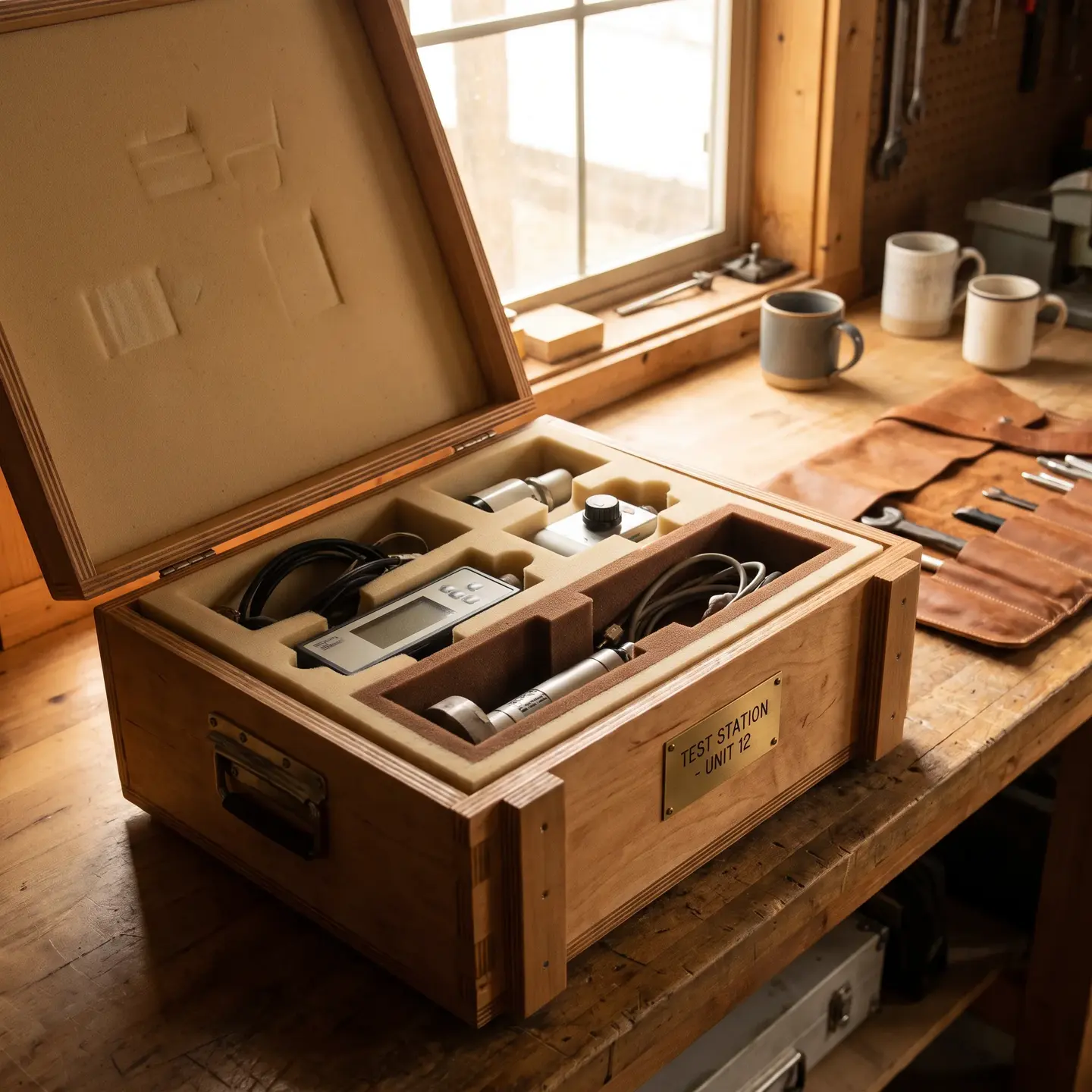
Generic foam corners protect against corner impacts. Test equipment needs protection at every interface: the base, the sides, the top, and around any protrusions or delicate components. We specify foam density and indentation load deflection (ILD) based on the equipment’s mass and sensitivity, ensuring the foam absorbs energy without bottoming out during impacts and without creating pressure points that stress the equipment’s frame. For particularly sensitive instruments, we use CNC-cut blocking that fits the equipment’s exact geometry, immobilizing it completely within the crate.
Integrated Shock and Tilt Indicators
Every crate we build for six-figure instruments includes shock indicators calibrated to thresholds appropriate for the equipment’s sensitivity. These indicators record whether the crate experienced impacts above acceptable limits, providing documentation you can use for insurance claims and receiving verification. Tilt indicators show whether the crate was handled improperly, such as being laid on its side when it should have remained upright. This evidence shifts liability and accelerates claims when damage occurs.
Moisture Barrier Systems
For shipments involving ocean freight, extended storage, or transit through humid climates, we seal the equipment inside a vapor barrier enclosure with industrial desiccants. This creates a controlled micro-environment that maintains low humidity throughout transit, preventing condensation and corrosion. The barrier material is sealed completely, not just draped over the equipment, so moisture cannot migrate in through gaps or seams.
Compliance and Documentation
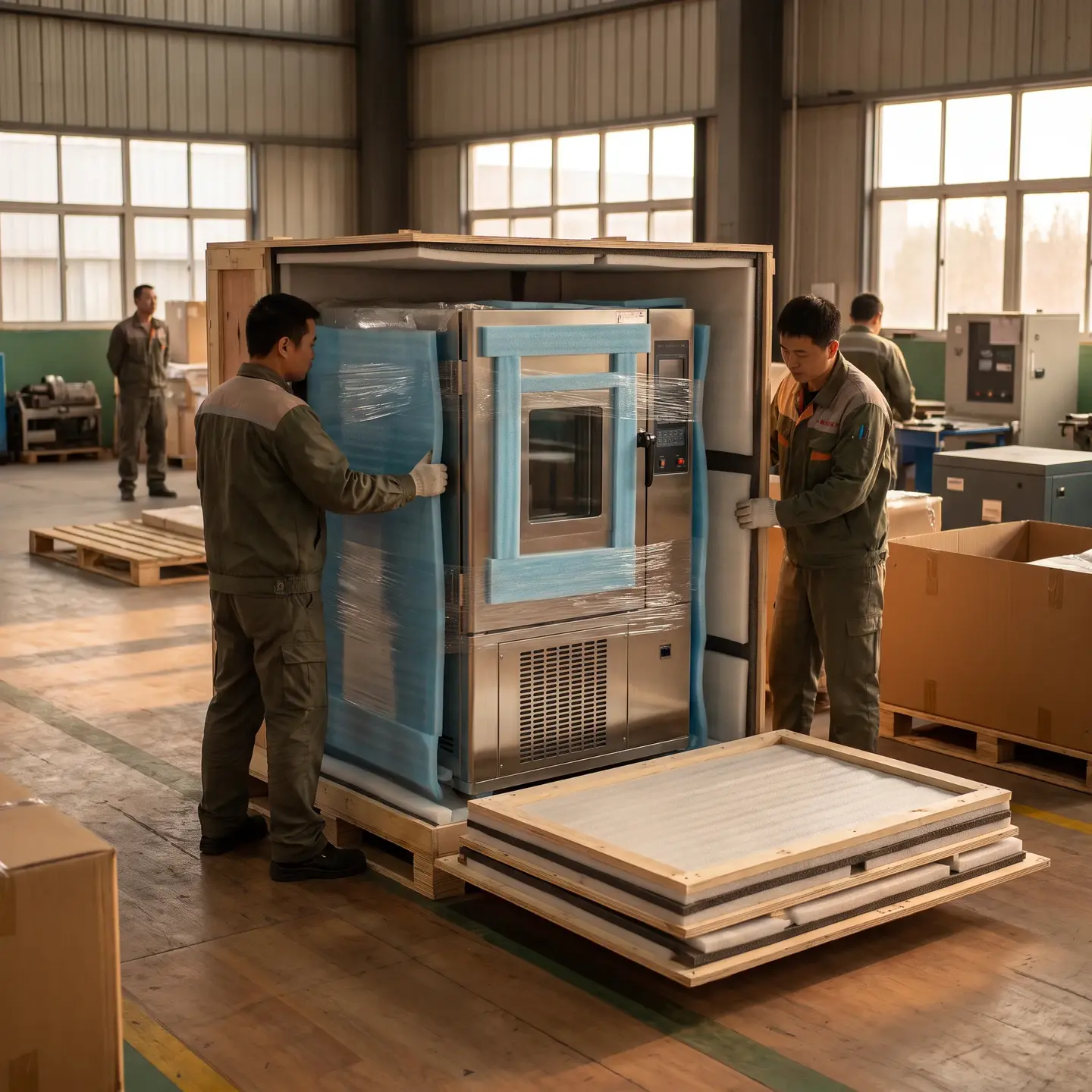
Our crates meet ISO packaging and transport standards and are built from ISPM-15 certified heat-treated wood for international shipments. We provide documentation of the packing process, including photographs, indicator readings at closure, and instructions for uncrating that ensure the receiving team knows exactly how to open the crate without damaging the equipment.
Named Asset Examples: What Qualifies as High-Stakes Equipment
Not every instrument needs this level of protection. But the following categories almost always do:
- Universal testing machines: These systems measure material properties like tensile strength, compression, and fatigue. Their load cells and extensometers are calibrated to tight tolerances that drift from mechanical shock.
- Environmental chambers: Used for temperature and humidity testing, these chambers contain refrigeration systems, heating elements, and control electronics that are sensitive to both shock and orientation.
- Spectroscopy equipment: Mass spectrometers, optical emission spectrometers, and similar instruments contain optical paths and vacuum systems that cannot tolerate vibration or contamination.
- Semiconductor test stations: These systems test wafers and chips using probes positioned with micron-level accuracy. Any mechanical disturbance can require complete realignment.
- Metrology instruments: Coordinate measuring machines, optical comparators, and similar systems measure to tolerances that make them among the most shock-sensitive cargo that exists.
- Automated inspection systems: Vision systems, X-ray inspection equipment, and CT scanners combine delicate optics with heavy mechanical assemblies, requiring protection at multiple levels.
If you recognize your equipment on this list, you are the reader we wrote this article for. Our high-tech equipment crating solutions are designed specifically for these asset types.
Uncrating Documentation and Receiving Protocols
Protection does not end when the crate arrives. The uncrating process itself can damage equipment if done improperly, and the documentation created during uncrating determines whether you can file successful claims if damage is discovered.
What Proper Uncrating Documentation Includes
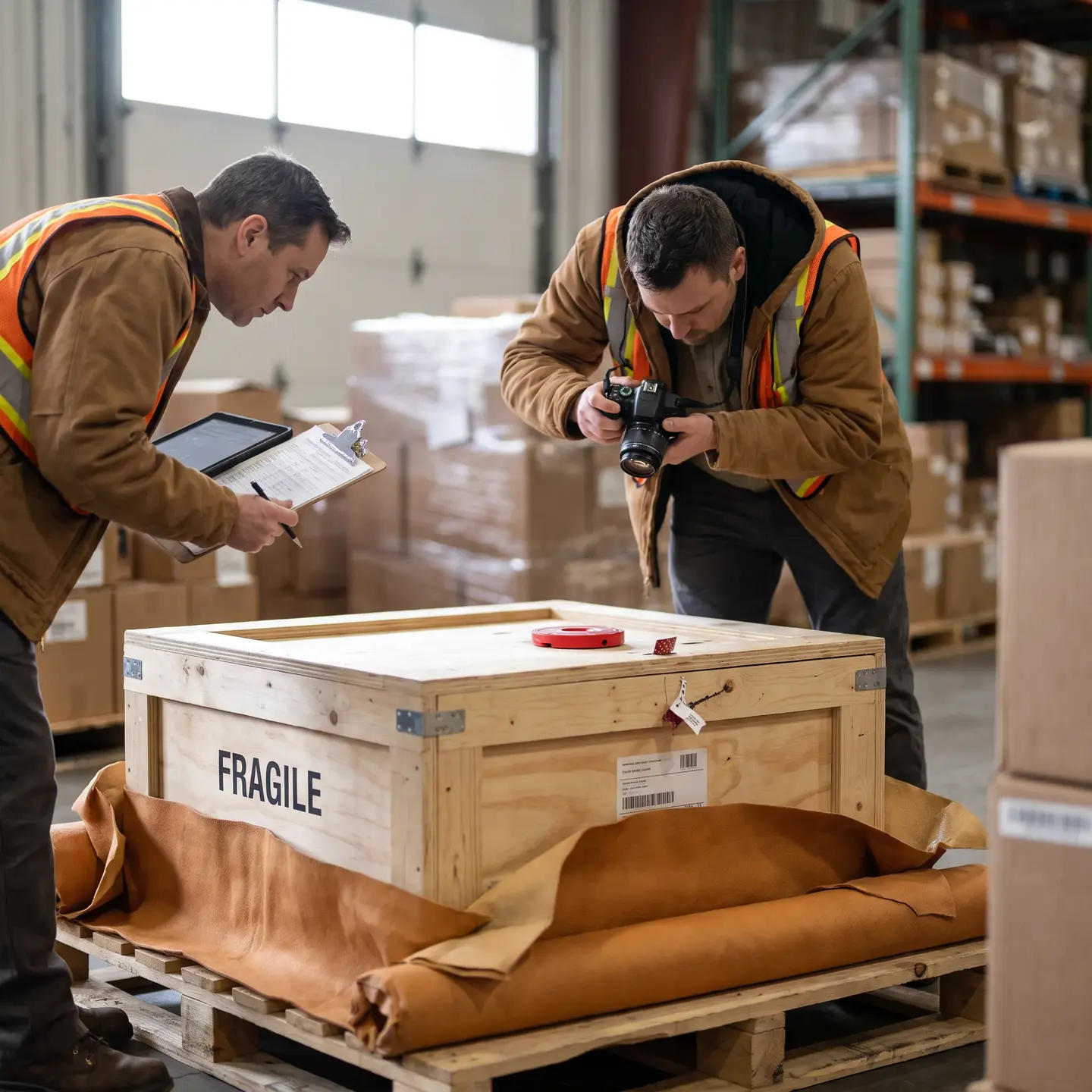
- Photographic evidence of crate condition on arrival: Before opening anything, photograph the exterior of the crate from all angles. Document any visible damage, even minor scuffs or dents that might indicate rough handling.
- Indicator verification before opening: Check shock and tilt indicators before breaking the seal. Record their readings. If indicators show the crate was mishandled, document that evidence before proceeding.
- Step-by-step unpacking following provided instructions: The uncrating process should follow the sequence we specify, removing components in the correct order to avoid stressing the equipment or damaging internal protections.
- Condition reporting for each major component: As each part of the equipment is revealed, inspect and document its condition. Note any visible damage, moisture, or foreign material.
- Functional verification if possible: Before signing off on delivery, power up the equipment and run basic diagnostics if your facility allows. Discovering damage during initial testing strengthens your position compared to discovering it days or weeks later.
This documentation creates a paper trail that protects you. When you file a claim, you have timestamped evidence showing the condition of the crate on arrival, the indicator readings, and the state of the equipment when uncrated. Carriers and insurers have much less room to dispute claims when the evidence is this thorough.
When to Specify Custom Crating vs. Manufacturer Packaging
Not every shipment requires full custom crating. Here is a decision framework:
Custom Crating Is Likely Necessary When:
- Equipment value exceeds $50,000
- Transit involves multiple modes (truck, air, ocean) or international borders
- Original manufacturer packaging is unavailable or damaged
- Insurance requires documented packaging standards
- Equipment is calibrated and cannot tolerate shock above specific thresholds
- Transit distance exceeds 500 kilometers or involves known rough-handling segments
Manufacturer Packaging May Suffice When:
- Original packaging is intact and designed for transit (not just retail presentation)
- Shipping is local, single-mode, and under controlled conditions
- Equipment is relatively robust and not calibration-sensitive
- Replacement cost is low enough that risk is acceptable
When in doubt, consider the consequences of being wrong. If damage would cost you weeks of downtime and tens of thousands of dollars, the cost of custom crating is a small premium for certainty.
Working with a Crating Specialist
The process for protecting a six-figure test station follows a structured sequence:
- Consultation: We discuss the equipment, its sensitivities, the transit route, and any compliance requirements. For defence and aerospace clients, our Controlled Goods Program registration ensures your compliance chain remains intact.
- Assessment: We measure the equipment, identify mass distribution and delicate components, and determine the appropriate protection strategy. For complex equipment, this may involve on-site inspection.
- Design: We create a crate design using CAD tools, specifying materials, foam configurations, blocking, and indicators. You receive a detailed quote that itemizes each protective element.
- Fabrication: We build the crate in our Ottawa facility using ISPM-15 certified wood. Custom foam inserts and blocking are cut to fit.
- Packing and closure: We pack the equipment following controlled protocols, photograph the process, install indicators, and seal the crate with documentation.
- Coordination: We can coordinate with your freight forwarder or arrange transport through our logistics partners. For sensitive shipments, we recommend climate-controlled, air-ride transport.
The entire process aligns with International Safe Transit Association standards for packaging performance validation.
What Happens Next
If you have a test station, environmental chamber, or calibrated instrument that needs to move, the worst time to think about crating is when the freight truck is already scheduled. Start the conversation early. We can review your equipment specifications, recommend protection levels, and build lead time into your project schedule.
Request a quote through our website, or call our Ottawa shop directly. We will ask about the equipment, the destination, and the timeline, then provide a detailed estimate that shows exactly what protection you are getting and why it matters for your specific asset.
Your test equipment represents years of investment and capabilities your operation depends on. The crate that carries it should reflect that value.
Frequently Asked Questions
How do we quantify the real risk of shipping a six‑figure test station?
We look beyond replacement cost and focus on downtime and cascading delays. A single mishandled shipment can halt production testing for weeks, trigger missed delivery dates, and even penalty clauses in contracts. On top of that, you face $21,000 in round‑trip freight for repair, plus recalibration time measured in days or weeks to meet NIST or equivalent standards. We treat that combined risk as the baseline problem custom crating must solve.
Why isn’t standard freight packaging enough for our calibrated instruments?
Standard packaging assumes every box behaves the same under shock, vibration, and humidity. Our equipment doesn’t. Heavy frames hide load cells, optics, and micro‑positioning stages that drift out of spec from impacts we would never feel walking across a room. Generic foam and pallets don’t manage uneven weight distribution or tuned shock isolation. That is why we start from specific failure modes—shock, moisture, and tipping—and design protection backward from what can go wrong.
How does engineered crating actually reduce damage and claim headaches?
We use 3D modeling to map mass, contact points, and stress zones, then build blocking into structurally strong areas instead of delicate assemblies. At every interface, we specify foam density and indentation load deflection so energy is absorbed without bottoming out or creating pressure points. Integrated shock and tilt indicators document mishandling in transit, shifting liability and speeding insurance claims. The result is lower probability of damage and a stronger evidence trail when damage still occurs.
When should we insist on custom crating instead of trusting manufacturer packaging?
We push for custom crating when equipment value exceeds roughly $50,000, when transit is multi‑mode or crosses borders, or when instruments are calibration‑sensitive and shock‑limited. Manufacturer packaging can be enough for local, controlled shipping of robust gear. The trade‑off is simple: if being wrong means weeks of downtime and five‑figure repair bills, the added cost of engineered crating is a small premium for predictable performance and documented protection.
What receiving and uncrating practices protect us if damage is discovered?
We treat uncrating as part of the protection system, not an afterthought. On arrival, we photograph the crate from all angles, record shock and tilt indicator status before opening, then follow a step‑by‑step unpacking sequence. As each major component is exposed, we document its condition and, where possible, run basic functional checks before signing off. This disciplined process creates timestamped evidence that strengthens our position with carriers and insurers if problems appear.